New York water system cybersecurity requirements: Appendix 5-E
What New York's Department of Health Appendix 5-E (10 NYCRR Subpart 5-1) requires of community water systems serving more than 3,300 people: the vulnerability analysis, cybersecurity program, access rules, asset inventory and incident response plan, 24 hour incident reporting and 48 hour vulnerability reporting, and what is due by January 1, 2027.
Free checklist
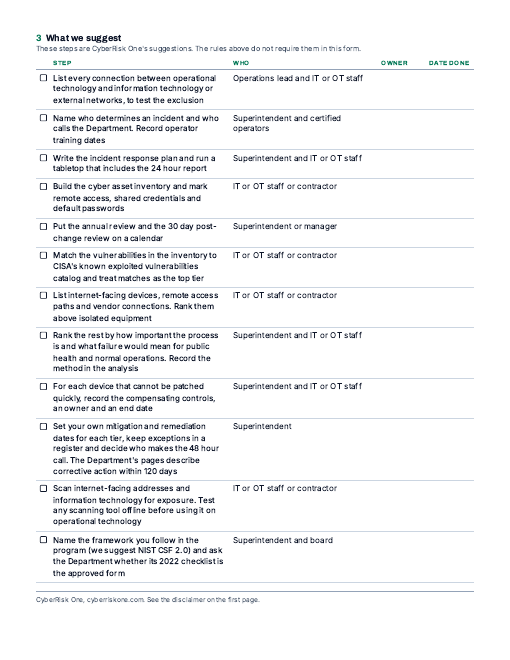
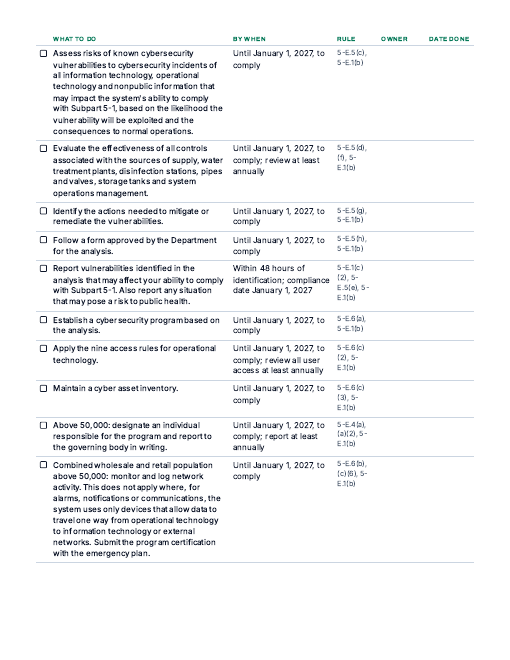
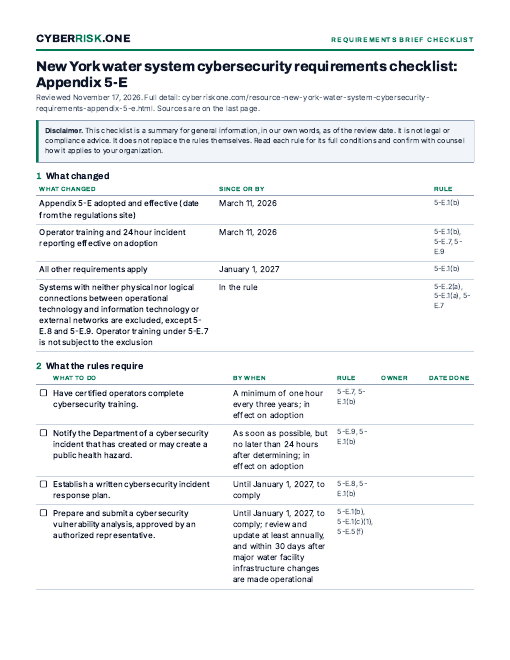
What changed, what the rules require and by when. Print it and assign the items, with sources.
Get the free checklist01
The short answer
The New York State Department of Health (the Department) adopted Appendix 5-E to 10 NYCRR Subpart 5-1 on March 11, 2026. It applies to community water systems that serve populations greater than 3,300 people. Added duties apply to systems that serve a combined wholesale and retail population of greater than 50,000.15 Operator training and Department incident reporting took effect on adoption. A covered water system has until January 1, 2027 to comply with the rest.1
The rule requires a cybersecurity vulnerability analysis and a cybersecurity program based on its findings. The program includes nine access rules, set out in the Appendix itself, for operational technology, the hardware and software that monitor and control the water system's physical processes, and a cyber asset inventory. A written incident response plan is also required. The rule names no outside framework. A covered system must notify the Department as soon as possible, but no later than 24 hours after determining that an incident has occurred which has created or may create a public health hazard. From January 1, 2027, vulnerabilities found in the analysis that may affect compliance, or any situation that may pose a risk to public health, go to the Department within 48 hours of identification.14
The work now is to put the incident reporting steps and training records in place, then finish the analysis, the program, the inventory, the access changes and the written incident response plan before January 1, 2027. We suggest the analysis include a ranked list of known vulnerabilities, with those attackers already exploit and those reachable from the internet first. We also suggest naming the framework you follow, such as NIST CSF 2.0.
This page is for water system superintendents and managers, certified operators, municipal leaders and boards, and the IT or OT staff or contractors who support covered community water systems in New York.
02
What a mature program is trying to achieve
Know what is connected to your treatment and distribution systems and which known vulnerabilities could hurt public health or normal operations, then be able to show the decision you made on each. We suggest five questions a mature program can answer quickly.
- 1Which of our information technology and operational technology systems are connected to each other or to the internet?
- 2Which known vulnerabilities affect them?
- 3Which of those are being exploited, and which processes matter most for public health?
- 4Who owns the fix? Where a device cannot be patched quickly, who owns the compensating control, the alternative measure put in its place?
- 5What evidence shows it worked, and that we reported to the Department when the rule required it?
03
What the rules and the Department expect
Appendix 5-E sets the requirements. The Department explains how it reads them. Training and incident reporting are in force now. The rest is due January 1, 2027.
In force since March 11, 2026
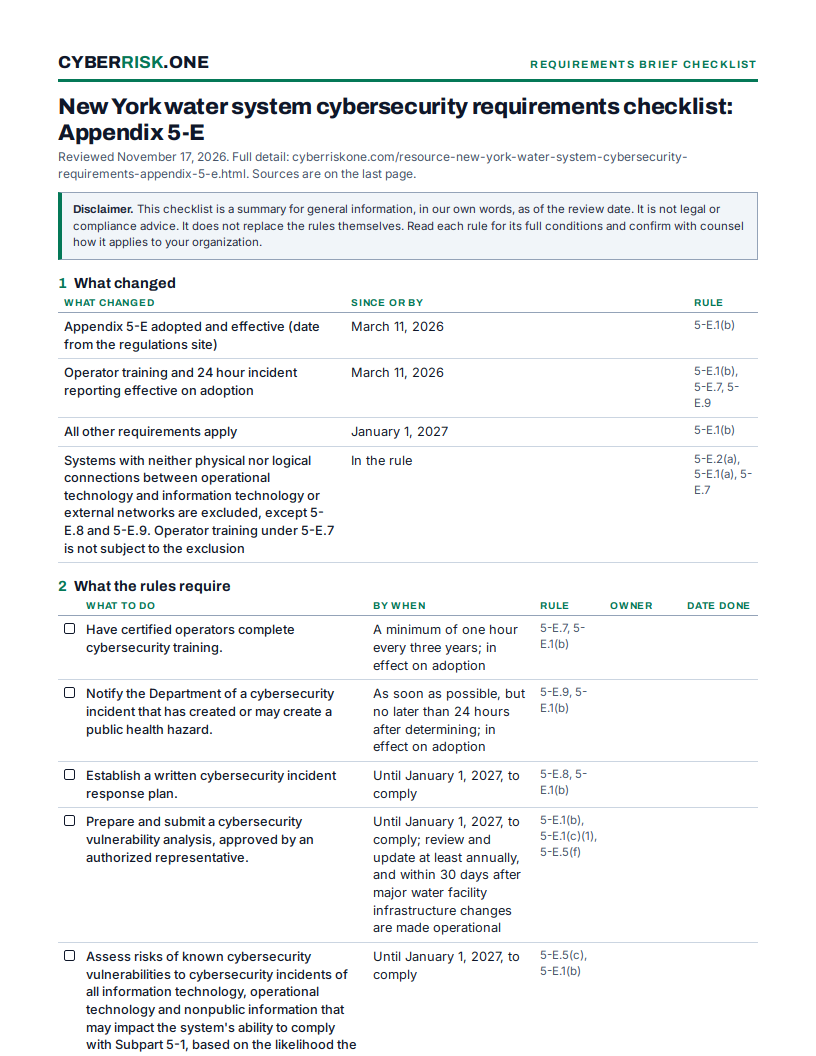
- Certified drinking water operators complete at least one hour of cybersecurity training every three years, with a curriculum the Department approves. No exclusion applies to this section (5-E.7, 5-E.1(a)).1
- Notify the Department as soon as possible, but no later than 24 hours after determining a cybersecurity incident has occurred which has created or may create a public health hazard (5-E.9).1
By January 1, 2027: all covered systems
- Prepare and submit a cybersecurity vulnerability analysis, approved by an authorized representative. Review and update it at least annually (5-E.1(c)(1), 5-E.5).1
- Within 48 hours of identification, report vulnerabilities identified in the analysis that may affect your ability to comply with Subpart 5-1 or any situation that may pose a risk to public health (5-E.1(c)(2)).1
- Establish a cybersecurity program based on the analysis, including a cyber asset inventory and nine access rules written into Appendix 5-E itself, numbered (i) to (ix) (5-E.6, 5-E.6(c)(2)).1
- Establish a written cybersecurity incident response plan (5-E.8).1
By January 1, 2027: combined wholesale and retail population above 50,000
- Designate an individual responsible for the cybersecurity program and name them in the water supply emergency plan (5-E.4(a), (a)(1)).1
- That individual reports in writing, confidentially, at least annually to the governing body (5-E.4(a)(2)).1
- Monitor and log network activity. Be prepared to produce the logs in the event of a cyber incident for investigative purposes. This does not apply if the system, for alarms, notifications or communications, uses only devices that allow data to travel one way from operational technology to information technology or external networks (5-E.6(c)(6)).1
- Submit a certification with the emergency plan that the program meets 5-E.6(c) (5-E.6(b)).1
The reporting deadlines
- Incidents: 24 hours, in effect now. Notify the Department "as soon as possible, but no later than 24 hours after determining" a cybersecurity incident has occurred which has created or may create a public health hazard.1 The Department takes these through an online form that must be completed in one session.2
- Vulnerabilities: 48 hours, from January 1, 2027. Report vulnerabilities identified in the analysis that may affect your ability to comply with Subpart 5-1, "or any situation that may pose a risk to public health," within 48 hours of identification.1 The Department asks for an email with contact details only and no technical detail.34
- Correction: 120 days. Not meeting 5-E.1(c) is a significant deficiency. Appendix 5-E says significant deficiencies "shall be corrected within 120 days in accordance with subdivisions 5-1.71(c) and 5-1.71(d)."1 This page does not cover what subdivisions 5-1.71(c) and (d) require within the 120 days. Confirm that with the Department before you set a corrective action schedule. The Department's table describes consulting within 30 days and starting or completing corrective action within 120 days of notification.3
Under 5-E.2(a), a covered water system that has neither physical nor logical connections between operational technology and information technology or external networks is not required to meet the Appendix, except 5-E.8 and 5-E.9. The written incident response plan (5-E.8) and Department incident reporting (5-E.9) still apply. Operator training (5-E.7) also still applies, because 5-E.1(a) puts it outside the exclusions. The Department has an exclusion request form.12
Read the detail on what Appendix 5-E requires, including the exclusions and the definitions
Each card gives the rule's own terms and its section number. Read each section for its full conditions.1
A cybersecurity vulnerability analysis
Assess known vulnerabilities in information technology, operational technology and nonpublic information by likelihood of exploitation and consequence to normal operations. Identify the actions to mitigate or remediate. Follow a form the Department approves. Basis: 5-E.5.
A cybersecurity program
The program is established on the findings of the analysis. It is designed to perform eight functions, including reporting, access management, the asset inventory, protection, risk assessment, response and recovery. Basis: 5-E.6(a), (c).
A cyber asset inventory
Operational technology assets reachable or accessible by a management, control or communications protocol, and information technology assets physically or logically connected to operational technology. Basis: 5-E.3(c), 5-E.6(c)(3).
Operator training and a written response plan
At least one hour of cybersecurity training every three years for certified operators. A written cybersecurity incident response plan for each covered water system. Basis: 5-E.7, 5-E.8.
The nine access rules
Section 5-E.6(c)(2) spells out these nine rules in the text of Appendix 5-E itself. A covered water system must meet them by January 1, 2027, unless the exclusion under 5-E.2(a) applies. The numbers below follow the rule's own.
- (i) Multi-factor authentication for anyone accessing operational technology from an external network, unless an authorized representative or the individual responsible for the cybersecurity program has approved the use of compensating controls in writing.
- (ii) Access privileges for operational technology and nonpublic information limited to what each user's assigned tasks need.
- (iii) User accounts for operational technology separate from user accounts for information technology.
- (iv) Unique credentials for each authorized user whenever the operational technology can support them. Compensating controls where it cannot. Above 50,000, the individual responsible for the program documents those controls in writing.
- (v) All user access privileges reviewed at least annually, with accounts and access no longer needed removed or disabled. Access terminated immediately on departure, or on a change of role such that access is no longer required. Shared credentials changed immediately, or compensating controls put in place.
- (vi) All remote access to operational technology that is not necessary to monitor or operate the system disabled.
- (vii) The functions of remaining remote access limited to those necessary to monitor or operate the system.
- (viii) All protocols that permit remote access to operational technology or nonpublic information securely configured.
- (ix) No default passwords in operational technology. Compensating controls where a default password cannot be changed.
Basis: 5-E.6(c)(2)(i) to (ix).
Systems that serve a combined wholesale and retail population of greater than 50,000 have extra duties.
A designated individual
Deemed qualified by the owner, with "demonstrable knowledge of cybersecurity principles and practical experience in system protection or risk management." The name and contact details go in the water supply emergency plan. Basis: 5-E.4(a).
Reports and approval
A confidential written report at least annually to the governing body on the program and material cybersecurity risks. This person also approves the analysis and documents compensating controls for credentials. Basis: 5-E.4(a)(2), 5-E.5(b), 5-E.6(c)(2)(iv).
Monitoring and certification
Monitor and log network activity. The paragraph does not apply if, for alarms, notifications or communications, the system uses only devices that allow data to travel one way from operational technology to information technology or external networks. Submit a certification with the emergency plan that the program meets 5-E.6(c). Basis: 5-E.6(c)(6), 5-E.6(b).
The exclusion is narrow. Section 5-E.2(a) excuses a covered water system from the Appendix, except sections 5-E.8 and 5-E.9, if it "has neither physical nor logical connections between operational technology and information technology or external networks." Sections 5-E.2(b) and (c) exempt billing systems operated and managed by a municipal corporation, and information technology that does not affect a covered water system's ability to comply with Subpart 5-1.1
The rule defines its key terms. A "cybersecurity incident" is a cybersecurity event or attack that meets any one of the descriptions in 5-E.3(e). It directly or indirectly has an adverse impact on operations that affect compliance with Subpart 5-1. Or it has a reasonable likelihood of compromising operations or components. Or it actually or imminently jeopardizes the confidentiality, integrity or availability of nonpublic information or results in loss or damage to normal operations. "Multi-factor authentication" requires at least two of: something the user knows, has or is (5-E.3(i)).1
The Department's pages put the exclusion in plainer words. They say the same as the rule on 5-E.8, 5-E.9 and 5-E.7. On billing systems, the overview page describes systems not under the system's direct control, while the rule says "operated and managed by a municipal corporation." Where they differ, this page follows the rule.12
Read the detail on the reporting deadlines, including where the Department's pages and the rule text differ
A covered water system has two reports to the Department, with different triggers and start dates.1
Incidents: 24 hours, in effect now
Notify the Department "as soon as possible, but no later than 24 hours after determining" a cybersecurity incident has occurred which has created or may create a public health hazard.1 The Department takes these through an online form that must be completed in one session.2 Basis: 5-E.9.
Vulnerabilities: 48 hours, from January 1, 2027
Report vulnerabilities identified in the analysis that may affect your ability to comply with Subpart 5-1, "or any situation that may pose a risk to public health," within 48 hours of identification.1 The Department asks for an email with contact details only and no technical detail.34 Basis: 5-E.1(c)(2), 5-E.5(e).
Correction: 120 days
Not meeting 5-E.1(c) is a significant deficiency. Appendix 5-E says significant deficiencies "shall be corrected within 120 days in accordance with subdivisions 5-1.71(c) and 5-1.71(d)."1 This page does not cover what subdivisions 5-1.71(c) and (d) require within the 120 days. Confirm that with the Department before you set a corrective action schedule. The Department's table describes consulting within 30 days and starting or completing corrective action within 120 days of notification.3 Basis: 5-E.1(d).
Note: The notice under 5-E.9 "does not replace any other notifications required under State or Federal laws or regulations." Municipal corporations and public authorities must also report cybersecurity incidents to the Division of Homeland Security and Emergency Services (DHSES) within 72 hours of reasonably identifying that a cybersecurity incident has occurred, ransom demands included, and ransom payments within 24 hours of making them. Check each incident against the DHSES reporting requirement separately.17
The incident trigger in the rule is the determination. The rule says 24 hours "after determining" that an incident has occurred which has created or may create a public health hazard. The Department's pages describe 24 hours from identification or discovery of incidents that could affect compliance or pose a public health risk.123 This page quotes the rule. Build your procedure around the rule's wording and confirm how the Department applies it.
The two reports cover different things. The 24 hour report is for a cybersecurity incident, as defined in 5-E.3(e), that has created or may create a public health hazard (5-E.9). The 48 hour report is for vulnerabilities found in the analysis, or any situation that may pose a risk to public health. The incident report is made in a manner the Department prescribes under 5-1.77(a).1
04
The practices that follow
These six steps are our suggestions for doing the work above and being able to show it. Write them into your program. Adjust each step to your environment, size, risk appetite and other factors unique to you.
- Check whether the exclusion could apply to youList every connection between operational technology and information technology or external networks, including remote access and vendor links. Have the operations lead and the IT or OT staff agree on the list. A system with such a connection is not excluded.
- Write and test the incident response planDescribe the tasks to maintain or restore compliance during or after an incident. Run a tabletop exercise, where the team talks through a practice incident, that includes the 24 hour Department report.
- Set the ranking first and then find and fix vulnerabilities in that orderPut first the vulnerabilities attackers are already exploiting, using CISA's known exploited vulnerabilities catalog.14 Next come vulnerabilities on devices reachable from the internet, on remote access paths and on vendor connections.1516 Then rank the rest by how important the process is and what failure would mean for public health and normal operations. The rule requires assessment by likelihood of exploitation and consequences to normal operations (5-E.5(c)).1 We suggest using process importance and potential public health effects to help assess the consequences. Find them with the Department's checklist and a vulnerability scan where it can be done safely.1112 Test any scanning tool offline before using it on operational technology.17 Where a device cannot be patched quickly, record the compensating controls, an owner and an end date.15
- Confirm incident reporting and training are workingWrite down who determines that an incident may create a public health hazard, who makes the call to the Department and how. Check each certified operator's record of cybersecurity training with a curriculum the Department approves. Record the date of the last hour completed and when the next one is due.
- Build the cyber asset inventory and check the nine access rules against itList the operational technology that can be reached by a management, control or communications protocol and the IT assets connected to it. Mark the remote access, shared credentials and default passwords the inventory shows.
- Put the analysis on a calendarSet the annual review date. Plan for a review within 30 days after major water facility infrastructure changes are made operational (5-E.5(f)). Plan the approval, the Department form and the five-year submission the Department describes.34
Read the detail on what your program and plan should define
Appendix 5-E requires a vulnerability analysis, a program based on it and a written incident response plan. It lists what each must address.1 The cards below show what we suggest each document define. Adjust every part to your system's environment, size, risk appetite, compensating controls and other factors unique to it.
Scope and the cyber asset inventory
Which operational technology and connected information technology the program covers, and where the inventory lives. Name the assets the inventory does not cover and how staff review them instead. Basis: 5-E.3(c), 5-E.6(c)(3).
How vulnerabilities are assessed
How you rate the likelihood that a vulnerability will be exploited and the consequences to normal operations. How you evaluate controls at supply sources, treatment plants, disinfection stations, pipes and valves, storage tanks and operations management. Basis: 5-E.5(c), 5-E.5(d).
Mitigation and remediation actions
The actions needed to mitigate or remediate each vulnerability the analysis finds, with an owner and a target date. Appendix 5-E sets no number of days for these actions. We suggest you set a target date for each one. The 120 days to correct a significant deficiency is a separate deadline (5-E.1(d)). Basis: 5-E.5(g); our suggestion for the dates.
Who can reach what
The nine access rules, written for your operational technology. For each compensating control, an alternative measure put in place to satisfy a required security measure, record the reason and any approval the rule requires. We also suggest naming an approver for each one. Basis: 5-E.6(c)(2).
Defensive architecture and risk
Controls, compensating controls, policies and procedures that protect operational technology and nonpublic information. How internal and external risks are identified and assessed. Basis: 5-E.6(c)(4), (5).
Reporting decisions
How a vulnerability or incident is recognized, who decides, who calls the Department and what the 24 hour and 48 hour reports contain. Which other notifications apply. Basis: 5-E.9, 5-E.1(c)(2), 5-E.6(c)(1).
Incident response and recovery
Tasks during or after an incident to maintain or restore compliance, to limit impacts on normal operations and to limit physical or structural damage. How normal operations and services are restored. Basis: 5-E.8, 5-E.6(c)(7), (8).
Review and approval
Who approves the analysis, when it is reviewed and what triggers an extra review. Above 50,000, the designated individual approves it and reports to the governing body. Basis: 5-E.5(b), (f); 5-E.4(a)(2).
The numbers in Appendix 5-E and what it leaves to you
| Item | What the rule sets | What the rule leaves to your system |
|---|---|---|
| Vulnerability analysis review | At least annually, and within 30 days after major water facility infrastructure changes are made operational (5-E.5(f)). | How the review is done and who contributes. |
| Analysis submission | The Department says every five years with the emergency plan, or within 30 days of a major infrastructure change. | The annual update is kept and produced on request, according to the Department. |
| Vulnerability report | Within 48 hours of identification (5-E.5(e)). | How you decide that a situation may pose a risk to public health. |
| Incident report | As soon as possible, but no later than 24 hours after determining (5-E.9). | Who makes the determination, and how fast. |
| Access review | At least annually (5-E.6(c)(2)(v)). | Who reviews, and how it is recorded. |
| Operator training | At least one hour every three years (5-E.7). | When in the three years each operator trains. The Department approves the curriculum. |
| Report to the governing body | Above 50,000 only: at least annually (5-E.4(a)(2)). | The report's format and content beyond the program and material risks. |
| Fixing a missed analysis or report | Non-compliance with 5-E.1(c), the analysis and the 48 hour vulnerability report, is a significant deficiency, corrected within 120 days (5-E.1(d)). | Deadlines for fixing what the analysis finds. The rule sets none. |
The rule sets the functions the program must perform. Section 5-E.6(a) requires a cybersecurity program based on the findings of the analysis. Section 5-E.6(c) says the program "shall be designed to perform" eight functions, from fulfilling reporting obligations to recovering from incidents.1 Section 5-E.8 requires a written incident response plan that "shall describe tasks to be performed during or following a cybersecurity incident to maintain or restore the covered water system's compliance with the requirements of this Subpart."1
The analysis follows a form the Department approves. Section 5-E.5(h) says the analysis "shall follow a form approved by the department." The Department also offers a program template, a vulnerability assessment checklist and a certification template.12
Review is annual and submission is separate. The rule requires the analysis to be reviewed and updated at least annually. The Department says it is submitted every five years with the emergency plan or within 30 days of a major infrastructure change, and that the annual update is kept and produced on request.134 The submission cycle described here comes from the Department's pages.34 Confirm how 5-1.33 applies to your system, or ask the Department, before you set a submission calendar.
05
What changed and when
The Governor announced proposed rules from the Department and the Department of Environmental Conservation in July 2025. Appendix 5-E was adopted on March 11, 2026, with two sections in effect at once and the rest due January 1, 2027.1510
How the requirements arrived
- Jul 2025Proposed rules announced
- Mar 11, 2026Adopted. Training and incident reporting begin
- Jan 1, 2027All other requirements apply
Read the detail on what changed and when
Who the rule covers
- Community water systems that "serve populations greater than 3,300 people."1
- Sections 5-E.4 and 5-E.6(c)(6) apply only to systems with a combined wholesale and retail population of greater than 50,000.1
- Section 5-E.7 applies to all certified drinking water operators.1
- Billing systems operated and managed by a municipal corporation are exempt where they do not affect compliance with Subpart 5-1. So is information technology that does not affect compliance (5-E.2(b), (c)).1
What took effect on March 11, 2026
- Section 5-E.7, training, "shall be effective immediately upon adoption."1
- Section 5-E.9, Department reporting, is also effective immediately.1
- The regulations site lists an adopted date and an effective date of March 11, 2026.5
What is due January 1, 2027
06
What the rule does not say and what we recommend
This section lists what the rule leaves to your system. The first three cards are our reading of the text.1 The last card is what we recommend.
Framework and testing
- The text names no framework, such as NIST CSF or AWWA guidance.
- The text does not require penetration testing.
- It does not specify all-hours monitoring, a product or a retention period for logs.
Access and staffing
- Multi-factor authentication is required for access to operational technology from an external network. The text does not extend it to every local login.
- It does not require a full-time security officer. Above 50,000 the owner designates a person it deems qualified, and the rule does not say the person must be an employee.
Review and submission
- The analysis is reviewed annually. The text does not require submitting it annually.
- It sets no number of days to mitigate or remediate each vulnerability the analysis finds. The 120 days to correct a significant deficiency is a separate deadline (5-E.1(d)). The Department's pages describe corrective action within 120 days, counted from discovery in the FAQ and from notification in the requirements table.34
What we recommend
- Treat the analysis as a risk assessment of known vulnerabilities. Use scanning to find them where it can be done safely. The rule does not require scanning. The Department's program template lists "Vulnerability Scanning Software" among components that are "not required but are strongly recommended," and its 2017 letter said a scanner is "highly recommended."1213
- Name the framework you follow in the program. We suggest NIST CSF 2.0, which is for "any organization" and has an outcome that vulnerabilities in assets are "identified, validated, and recorded."18 The Department's own checklist maps its questions to version 1.0.11
- Treat penetration testing as optional. The rule does not mention it. We do not treat it as a baseline for a small system. That is our reading.
As of November 17, 2026, the sources listed on this page include no audit or enforcement results for Appendix 5-E. Most of its requirements are not yet due.
Free checklist
Get the checklist
Give us your email and we will send you a link to the downloadable checklist: what changed, what the rules require and what we suggest. 30 items you can print and assign, with the deadline and rule number for each requirement.
08
How we help
CyberRisk One helps covered water systems assess their gaps against Appendix 5-E, define risk for the vulnerability analysis and practice the 24 hour Department report.
A gap assessment against Appendix 5-E
We review your vulnerability analysis, program, inventory and access controls against the rule text and show where the evidence is thin.
A risk assessment for the analysis
We help define likelihood and consequence for your environment, so the analysis ranks vulnerabilities in terms your leadership can act on.
Tabletops and vCISO support
We run incident response tabletop exercises that include the 24 hour Department report. Our vCISO service works with your team to keep the program current and report to your governing body.