Cyber incidents cost more when you're not ready. Your decisions can change it.
Two organizations can experience the same cyberattack and face dramatically different financial consequences. One restores operations in a day. The other loses a week of productivity and revenue.
The difference often comes down to decisions made long before the incident.
How quickly could you restore critical systems? Could your business continue operating while those systems are unavailable?
Our calculator helps you explore how these factors affect the financial impact of an incident.
See what an incident could cost your organization, and what could change the outcome.
- Estimate the potential financial impact. Explore ransomware, business email compromise, data breaches and system or vendor outages, from contained incidents to severe disruptions.
- See how different decisions change the numbers. Adjust assumptions about recovery readiness, downtime and other factors to understand their potential financial impact.
- Understand what drives the costs. See how response, recovery, lost income and other expenses contribute to the total.
- Share the findings with leadership. Download a report with financial estimates, documented assumptions and supporting sources.
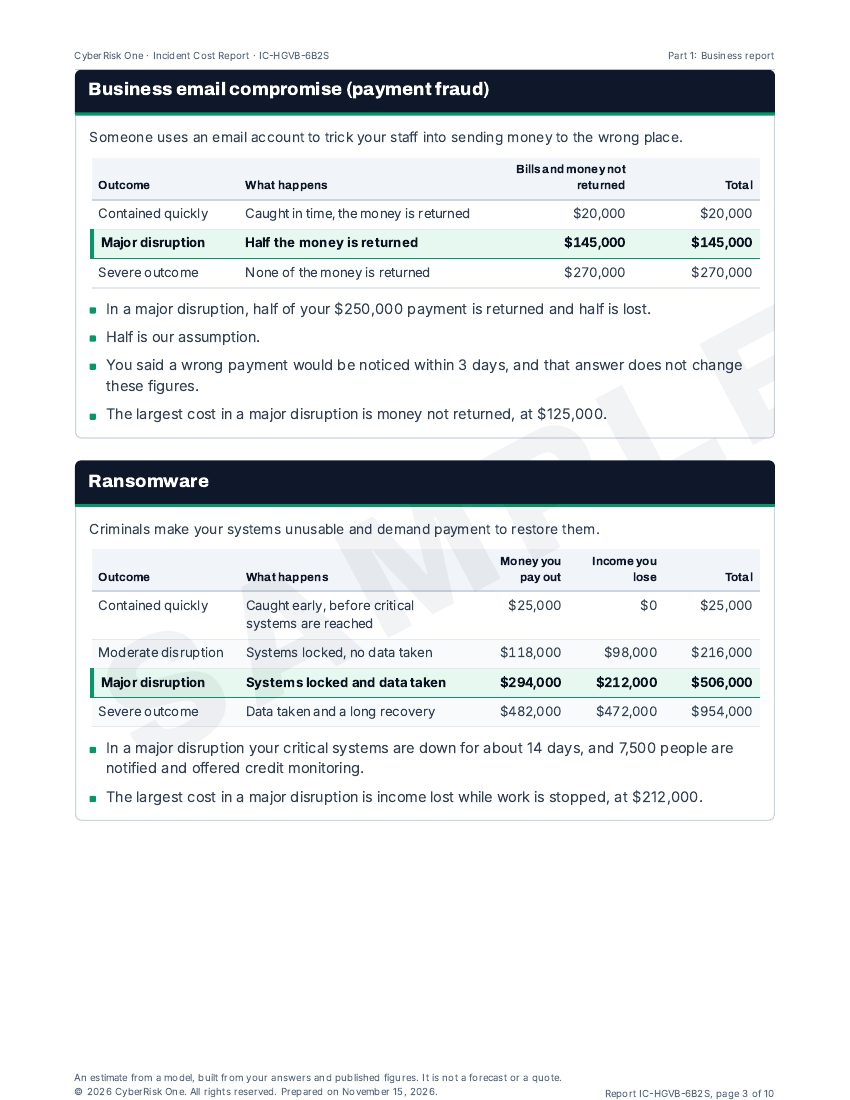
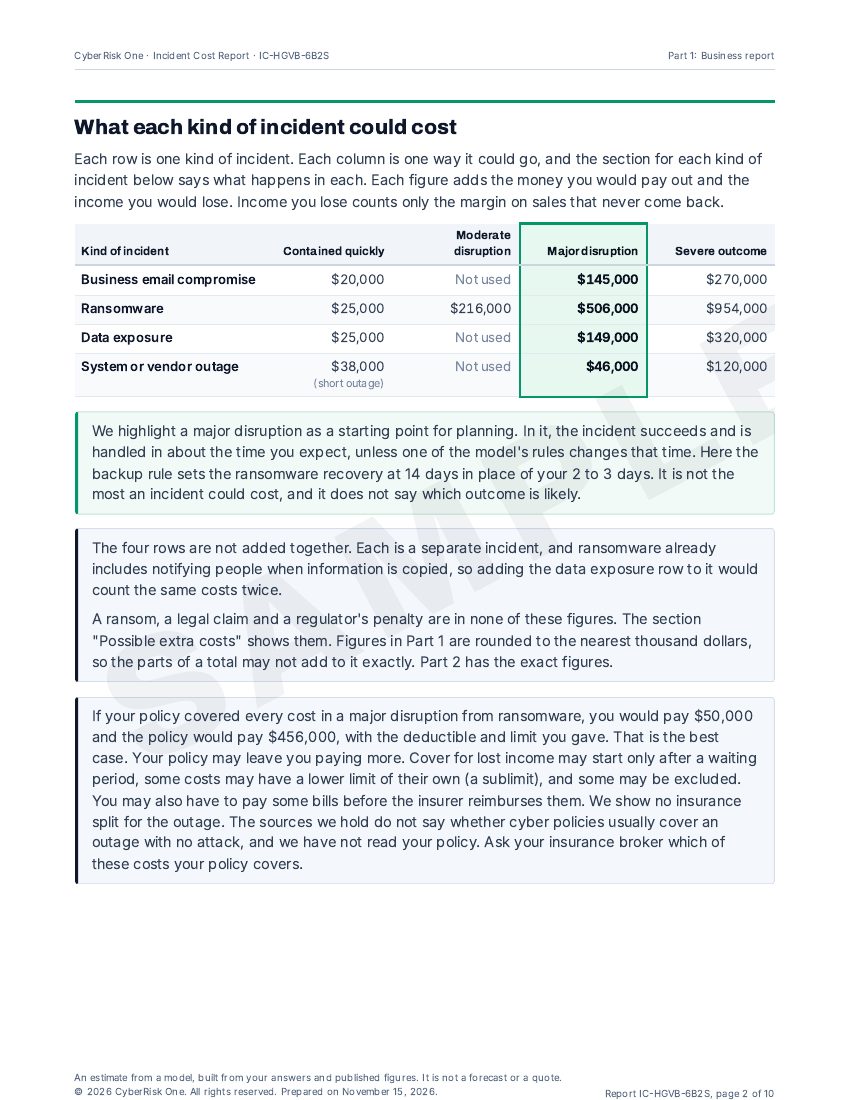
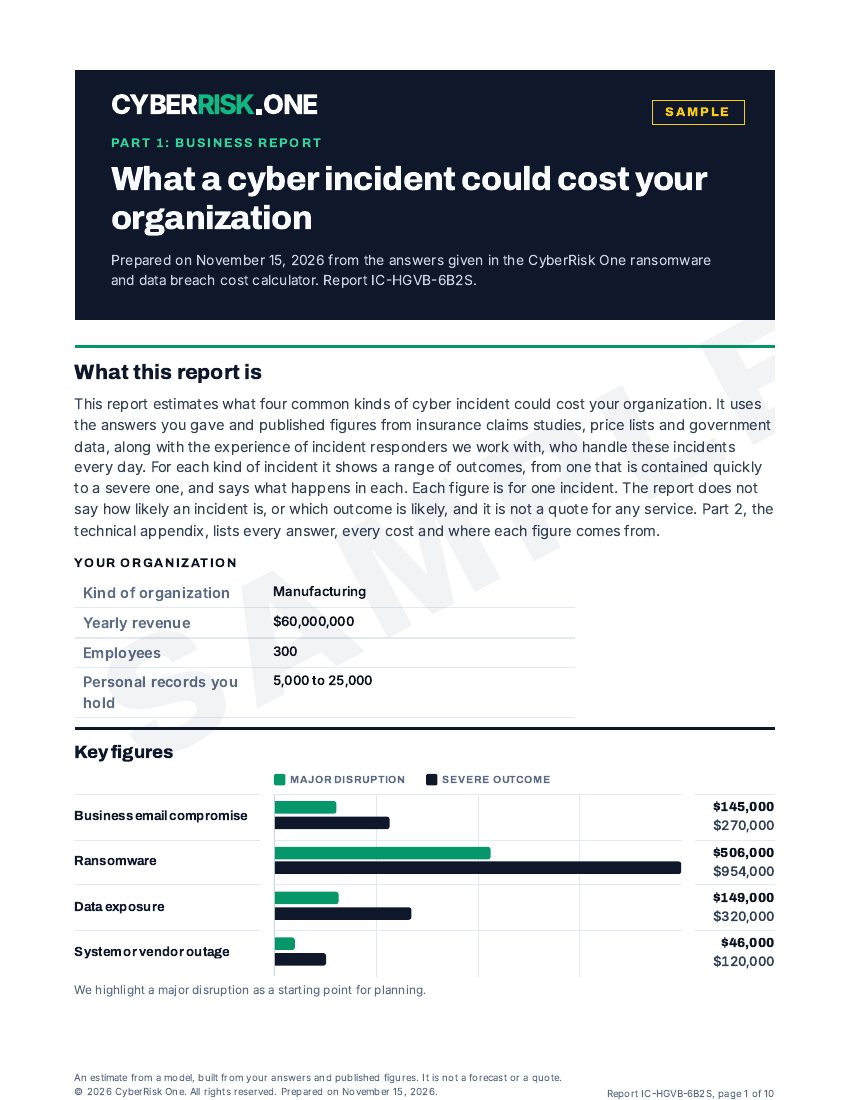
You can download a report to share with your leadership team.
Free to use. No sign-up required.Why is this free?
Real insights. Real numbers. What ransomware and data breaches have cost 30 organizations, by industry, each with its source. See the examples →
Start with your organization.
- Kind of organization
- Size
- Payments
- Information you hold
- How much would stop
- How long you could keep going
- Backup copy
- Restore test
- Time to restore
Free to use. No sign-up required.Why is this free?
Loading the engine's choices...
What you get
What you will walk away with.
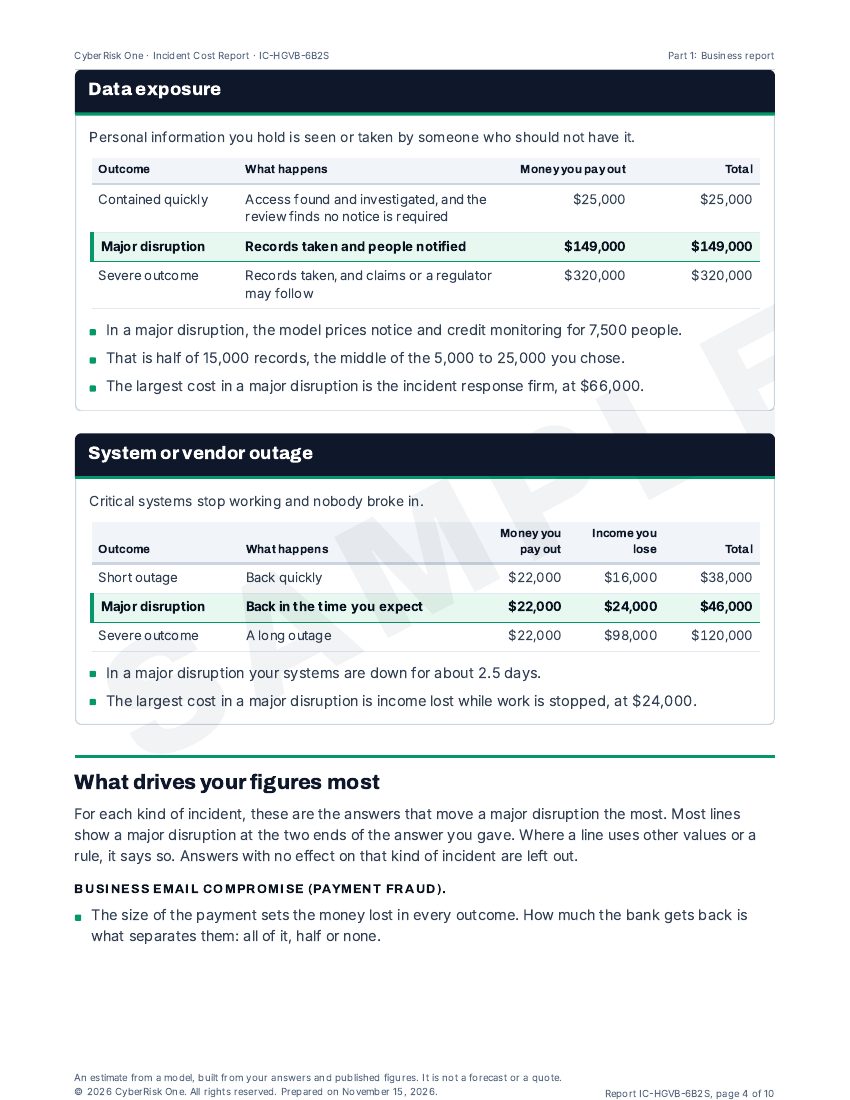
You can download a report to share with your leadership team.
- A range of estimated costs for each of the four kinds of incidentFrom an incident contained quickly to a severe outcome, with what happens in each. The range is a set of modeled outcomes and carries no probability.
- The costs that make up each figureSuch as outside help to respond, notifying people, credit monitoring, restoring systems and the income you lose while work is stopped.
- Costs that may or may not followShown apart from the total: a ransom, a legal claim and a regulator's penalty.
- A before and after viewIf you change an answer, such as how your backups are tested, the same model shows what that would mean for downtime and cost.
- Next steps that reduce your exposureSuch as practicing your incident response plan.
- Business email compromise
- How much does business email compromise cost?
- Ransomware
- How much does a ransomware attack cost?
- Data breach
- How much does a data breach cost?
- System or vendor outage
- How much does a system or vendor outage cost?
Business email compromise
How much does business email compromise cost?
Business email compromise is email fraud that tricks someone into sending money. For a hypothetical community bank with $400 million in total assets, the modeled range runs from about $20,000 to about $520,000. The example assumes the fraud takes one payment of $500,000, the largest single payment the bank entered. Most of the difference between the outcomes comes from how much of the payment is recovered.
- Contained quickly assumes all of the money comes back. About $20,000 of investigation and legal help remains.
- Major disruption assumes half of the money comes back. The bank's figure is about $270,000.
- The Severe outcome assumes none of it comes back. The whole $500,000 payment is lost. The bank's figure is about $520,000.
Ransomware
How much does a ransomware attack cost?
For a hypothetical manufacturer with about 300 employees and $60 million in revenue, the calculator's ransomware outcomes run from about $25,000 to about $1.8 million. Moderate disruption comes to about $260,000 and Major disruption to about $530,000. These are modeled examples, and your figures will depend on your own answers.
In Major disruption, about $280,000 of the total is income lost while work is stopped. The rest is cash spent on the response and recovery. A possible ransom is shown beside the result, as a range that depends on your revenue. It is not part of any total.
Change how your backups are tested and our calculator shows you the effect on downtime and cost. How backups change a ransomware result
Data breach
How much does a data breach cost?
The Data exposure tab is the calculator's data breach cost estimate. For a hypothetical medical group with about 250 employees, $45 million in revenue and records on 60,000 people, it runs from about $25,000 to about $950,000. That is a modeled example. The number of people whose records you hold has the largest effect on the figure.
It prices investigation, legal help, notices and credit monitoring. Major disruption assumes half of those people get a notice. In that case its total for this group is about $250,000. The Severe outcome assumes all of them get a notice. With half as many records, Major disruption would be about $160,000, and with twice as many about $450,000.
Notices and credit monitoring are priced per person from two published price lists, the NASPO ValuePoint cooperative contract (State of Idaho as lead state, April 2024) and the IDX Authorized GSA Price List 2026. In those lists the price for each person falls as the number of people grows. So for notices and credit monitoring, one cost per person does not fit every size of breach.
System or vendor outage
How much does a system or vendor outage cost?
Our calculator prices an outage that follows a cyber attack on your systems or an incident at a vendor you depend on, such as your payroll or banking provider. For a hypothetical manufacturer with about 300 employees and $60 million in revenue, a system or vendor outage is modeled at about $71,000 to about $910,000. Most of each figure is income lost while work is stopped. Your own answers on how much work stops and for how long set your figure.
For a hypothetical credit union with $250 million in total assets, the outage range is about $47,000 to about $210,000. The model assumes some interest income continues during an outage. It counts the extra hours staff work by hand. Losses on accounts overdrawn while balances could not be checked can be an institution's largest costs, along with fraud by members. The result shows these beside the total, with one credit union's own figures as an example.
More on what an incident costs
Why is the average cost of a cyber attack hard to use?
An average covers organizations of very different sizes, so it can be hard to apply to your own without knowing who was counted and which costs were included.
An average covers organizations of very different sizes, so it can be hard to apply to your own without knowing who was counted and which costs were included. In the calculator's modeled examples, ransomware runs from about $20,000 to about $470,000 for a hypothetical nonprofit with about 150 employees and $20 million in revenue. For a hypothetical private college with about 2,000 students, it runs from about $25,000 to about $1.2 million.
The calculator starts from your industry, your size, the information you hold and how quickly you could recover.
How much does incident response cost?
In the calculator, cash costs combine outside help to respond, notices and the work of restoring systems, so they are more than the price of response help alone.
In the calculator, cash costs combine outside help to respond, notices and the work of restoring systems, so they are more than the price of response help alone. In the modeled example for the hypothetical manufacturer, a ransomware attack that is contained quickly comes to about $25,000, all of it cash costs. In Major disruption the cash costs come to about $250,000. Lost income is shown separately.
Outside response help is priced from Verizon's 2026 Breach Impact Study and the NetDiligence Cyber Claims Study 2026, and most of those prices change with your size. How a result is built
How much cyber insurance do you need?
Our calculator gives you figures to set beside your cyber insurance limit and deductible.
Our calculator gives you figures to set beside your cyber insurance limit and deductible. After the first result you can enter both. Each outcome then shows an estimate of what you would pay and what the policy would pay. That split is worked out from those two amounts alone and treats every cost in the outcome as covered, so a real claim could pay differently. Check your policy for what it covers. For the hypothetical manufacturer, Major disruption for ransomware is about $530,000 and the Severe outcome about $1.8 million. That is a modeled example.
- Use each Severe outcome when you discuss your limit. Do this for each of the four tabs. Look as well at the ransom, legal claim and penalty shown apart from the total.
- Compare your deductible with each Contained quickly figure. A small incident can cost less than the deductible.
- Ask your broker which cost lines your policy covers. Include lost income and the ransom, legal claim and penalty shown apart from the total.
This comparison does not replace a review of your policy with your broker.
How accurate is the calculator?
We tested it against 21 real incidents whose costs became public: ransomware attacks, payment frauds and data exposures.
We tested it against 21 real incidents whose costs became public: ransomware attacks, payment frauds and data exposures. Twenty are public records listed with links on How we tested the calculator against real incidents, and one comes from an insurer's published claims report. The organizations ranged from school districts and counties to a community bank, a credit union and six public companies. We changed no figure to fit an incident.
- Three payment frauds landed inside the calculator's range. The organizations got back 97%, 52% and 34% of the money.
- Single bills at school districts came close, though three districts also informed how we priced the response, so that agreement counts for less. One bill for investigation and restoration ($55,142) and one for legal counsel ($18,850) were each near the calculator's figure.
- Three small school districts paid less than the calculator's figure. Its Major disruption figure was 1.3 to 3.8 times their response bills.
- Four public companies reported more. With $30 million to $370 million in revenue, they reported incident costs of $300,000 to $5.5 million, well above the calculator's response figures. A company filing gives one total, which may include overtime and security improvements beyond the response costs we compared. We have not established how much of the difference those costs explain.
The 21 incidents gave 31 dollar comparisons, because some incidents had more than one figure to compare. The Major disruption figure came out above the incident's own figure in 14 and below it in 10. The other 7 could not be counted either way. Those counts show direction only. The calculator is a model built on a small sample, so these tests cannot show how close its figures will be for your organization. How we tested the calculator against real incidents
Does it work for an organization our size?
We built the calculator to work for small, mid-size and large organizations.
We built the calculator to work for small, mid-size and large organizations.
In the calculator, the prices for outside response help change with the size of your organization. Lost income starts from your own revenue, assets or enrollment. For most businesses it uses the gross margin for your industry, which is the share of income left after the direct cost of what you sell. You can enter your own. The incidents we tested it against ran from school districts to public companies.
Questions about the calculator
Is the calculator free?
Yes. You answer the calculator's questions and see the result without signing up or giving contact details.
Do you store my answers?
We never record the figures you type, the results you see or anything that identifies you. To learn how the calculator is used, we count anonymous steps, such as the kind of organization and the size range chosen. Privacy
Is it a data breach cost calculator?
Yes. The Data exposure tab estimates the cost of a data breach, including investigation, legal help, notices and credit monitoring.
Is lost income included?
Yes. It is shown apart from cash costs.
Are a ransom and fines in the total?
No. A ransom, a legal claim and a regulator's penalty are shown beside your result and added to no total.
Why does it give a range?
The range shows several modeled outcomes and what happens in each, so you can see what drives the cost.
Does it give the odds of an incident?
No. It estimates what an incident could cost if one happens. The range carries no probability.
Where do the figures come from?
From public sources, the same ones the How it works page lists. Our calculator shows you the source of each figure.
- Response costs come from Verizon's 2026 Breach Impact Study and the NetDiligence Cyber Claims Study 2026, both of insured cyber claims.
- Ransomware figures come from Sophos, The State of Ransomware 2026 and The State of Ransomware in the U.S. 2026 (www.sophos.com).
- Notice and credit monitoring prices come from the NASPO ValuePoint cooperative contract (State of Idaho as lead state, April 2024) and the IDX Authorized GSA Price List 2026.
- Lost income uses the margin in IRS Statistics of Income, Corporation Complete Report, tax year 2023 for each industry. For bank, credit union and college income it uses federal data: FDIC BankFind financial data, June 30, 2026, NCUA call report data, Form 5300, June 2026 and National Center for Education Statistics, IPEDS Finance, fiscal year 2023.
- Recovering misdirected payments: FinCEN, Fact Sheet on the Rapid Response Program (April 15, 2026) and FinCEN, Business Email Compromise in the Real Estate Sector (March 30, 2023).
- Penalties: the HHS Office for Civil Rights resolution agreements and civil money penalties list and the New York Department of Financial Services consent orders for Order Express, Inc., Healthplex, Inc., Residential Mortgage Services, Inc. and Delta Dental Insurance Company.
- Backups: the #StopRansomware Guide from CISA, the FBI, NSA and MS-ISAC (October 2023), the joint advisory from the FBI, CISA and their partners #StopRansomware: Akira Ransomware, AA24-109A and NIST's IR 8374r1, Ransomware Risk Management: A Cybersecurity Framework 2.0 Community Profile.
- Other public records, such as board minutes and company filings, are named and linked where a result or How we tested the calculator against real incidents uses them.
What does it leave out?
Some costs, such as your own staff's time at normal pay, replacement hardware, lost customers and damage to your reputation.
How was it tested?
Against 21 real incidents whose costs became public. The matches and the misses are on the testing page. How we tested the calculator against real incidents
How CyberRisk One can help
Once you know what an incident could cost, the next question is which of your risks deserve attention first. A good place to start is a Risk Assessment built on a well-defined Risk Methodology that your business understands. IR Tabletop Exercises let your team practice its incident response. BCP/DR Plans, your business continuity and disaster recovery plans, set how quickly you plan to recover.
© 2026 CyberRisk One. All rights reserved. This calculator, its method and its wording may not be copied or reused without written permission.