New York school cybersecurity requirements: Part 121 and NIST CSF 2.0
What New York's Part 121 and Education Law 2-d require of school districts, BOCES and charter schools now that the standard is NIST CSF 2.0, plus the state's 72-hour incident reporting law, what state audits keep finding and where to start.
Free checklist
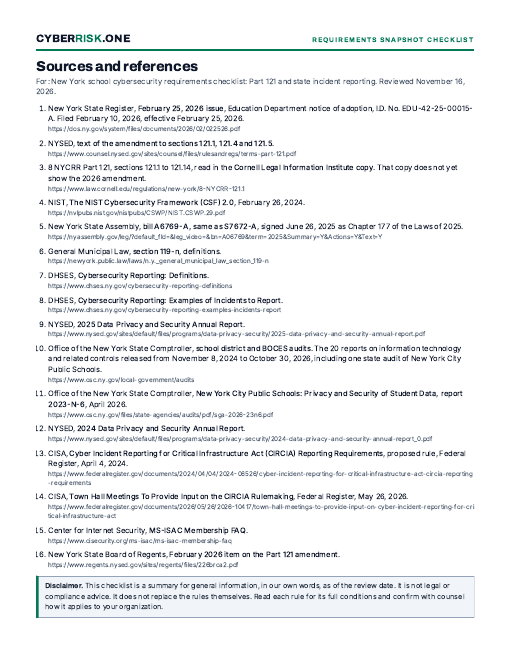
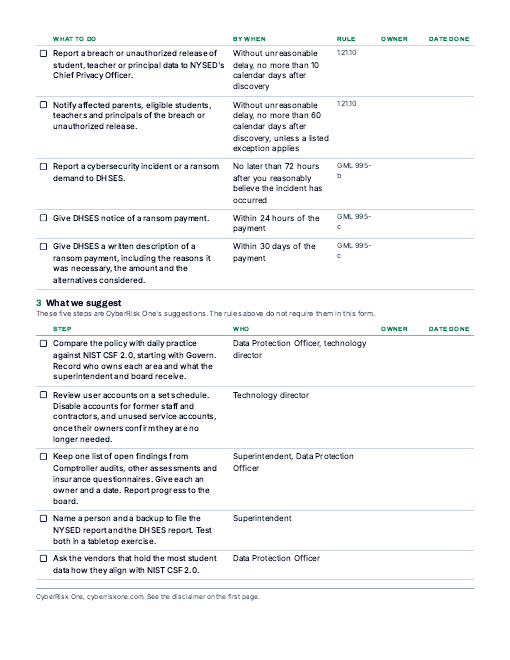
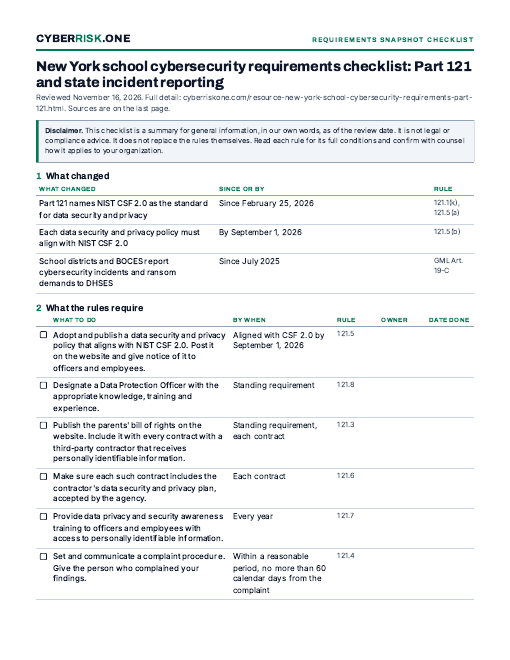
What changed, what the rules require and by when. Two pages to print and assign, with sources.
Get the free checklist01The short answer
New York's school data security rule, Part 121, now names version 2.0 of the NIST Cybersecurity Framework (CSF 2.0) as its standard. Each school district, BOCES and charter school had to align its data security and privacy policy with CSF 2.0 by September 1, 2026.12
Since July 2025 a separate state law also requires school districts and BOCES to report a cybersecurity incident to the state Division of Homeland Security and Emergency Services (DHSES) no later than 72 hours after they reasonably believe it has occurred.56 The 10-day breach report to the State Education Department (NYSED) still applies.3
The amendment did not add controls or change a reporting deadline. We suggest starting with two things. Check that daily practice matches the policy. Decide who files each report.
This page is for superintendents, school business officials, technology directors, Data Protection Officers and board members in New York public school districts, BOCES and charter schools.
02
What changed and when
NYSED amended Part 121 in February 2026. The amendment changed three provisions. It did not add controls or change a reporting deadline.12
How the requirements arrived
- January 2020Part 121 is adopted. The standard is NIST CSF 1.1.
- July 2025The state incident and ransom payment reporting law takes effect.
- February 25, 2026The Part 121 amendment takes effect. The standard is NIST CSF 2.0.
- September 1, 2026Policies must align with CSF 2.0 by this date.
- November 2026The federal incident reporting rule is still a proposal.
What the amendment changed
What CSF 2.0 adds
Who Part 121 covers
- School districts
- BOCES
- Schools, including charter schools
- NYSED itself3
Read the detail
NYSED amended Part 121 of the Commissioner's regulations, the rule that carries out Education Law 2-d. The amendment was filed on February 10, 2026 and took effect on February 25, 2026.1 It changed three provisions.2
The standard is now NIST CSF 2.0. Sections 121.1(k) and 121.5(a) replace Version 1.1 of the NIST Cybersecurity Framework with Version 2.0.2
Policies had to align by September 1, 2026. Section 121.5(b) says each educational agency's data security and privacy policy "shall align with the NIST CSF 2.0 no later than September 1, 2026."2
An outdated records reference was removed. Section 121.4(e) no longer cites a records retention schedule that the state replaced in 2021.216
The amendment touched only those three provisions. It did not add controls or change a reporting deadline.12
CSF 2.0 adds a sixth function called Govern. NIST published CSF 2.0 on February 26, 2024. Govern covers how an organization's "cybersecurity risk management strategy, expectations, and policy are established, communicated, and monitored."4 It also holds the framework's supply chain category, which covers risk that comes through vendors.4 For a district, Govern is the part of the framework that asks who owns cybersecurity risk and what the superintendent and board see.
03
What Part 121 still requires
The rest of Part 121 reads as it has since 2020.3 Each card gives the rule's own terms and its section number.
A published policy
Adopt and publish a data security and privacy policy that aligns with the NIST CSF. Post it on the website and give notice of it to officers and employees.
121.5
A Data Protection Officer
Designate one with "the appropriate knowledge, training and experience." A current employee "may perform this function in addition to other job responsibilities."
121.8
A parents' bill of rights
Publish it on the website. Include it with every contract with a third-party contractor that receives personally identifiable information.
121.3
Vendor contracts
Each contract with a third-party contractor that receives personally identifiable information includes the contractor's data security and privacy plan, accepted by the agency. Vendors align with the NIST CSF and encrypt personally identifiable information in motion and at rest.
121.6 and 121.9
Yearly training
Provide data privacy and security awareness training each year to officers and employees with access to personally identifiable information.
121.7
Complaints
Set and communicate a procedure for complaints about breaches or unauthorized releases. Give the person who complained the findings within a reasonable period and no more than 60 calendar days from receipt of the complaint.
121.4
Breach reports and notices
Report to NYSED's Chief Privacy Officer without unreasonable delay and no more than 10 calendar days after discovery. Notify affected parents, eligible students, teachers and principals without unreasonable delay and no more than 60 calendar days after discovery, unless a listed exception applies.
121.10
A risk assessment, if required
The Chief Privacy Officer may require an educational agency "to perform a privacy impact and security risk assessment."
121.13
Read the detail, including what changes for vendors
The rest of Part 121 reads as it has since 2020. It applies to school districts, BOCES, schools including charter schools, and NYSED itself. The rule calls them educational agencies.3
| Requirement | What the rule says |
|---|---|
| A published policy | Adopt and publish a data security and privacy policy that aligns with the NIST CSF. Post it on the website and give notice of it to officers and employees (121.5). |
| A Data Protection Officer | Designate one with "the appropriate knowledge, training and experience." A current employee "may perform this function in addition to other job responsibilities" (121.8). |
| A parents' bill of rights | Publish it on the website. Include it with every contract with a third-party contractor that receives personally identifiable information (121.3). |
| Vendor contracts | Each contract with a third-party contractor that receives personally identifiable information includes the contractor's data security and privacy plan, accepted by the agency (121.6). Vendors align with the NIST CSF and encrypt personally identifiable information in motion and at rest (121.9). |
| Yearly training | Provide data privacy and security awareness training each year to officers and employees with access to personally identifiable information (121.7). |
| Complaints | Set and communicate a procedure for complaints about breaches or unauthorized releases. Give the person who complained the findings within a reasonable period and no more than 60 calendar days from receipt of the complaint (121.4). |
| Breach reports and notices | Report to NYSED's Chief Privacy Officer without unreasonable delay and no more than 10 calendar days after discovery. Notify affected parents, eligible students, teachers and principals without unreasonable delay and no more than 60 calendar days after discovery, unless a listed exception applies (121.10). |
Summarized from the rule text.3 Read each section for its full conditions.
The state can require a risk assessment. Section 121.13 lets the Chief Privacy Officer require an educational agency "to perform a privacy impact and security risk assessment."3
The change reaches vendors too. Section 121.9 tells vendors to align with "the NIST Cybersecurity Framework," and section 121.1(k) now defines that term as Version 2.0.23 We read the two together to mean that vendors receiving student, teacher or principal data under a contract are expected to align with CSF 2.0. A district can ask its vendors how they have done so.
04
Two state reports with different deadlines
A district now reports to two state agencies under two laws. Each report has its own starting event. A single incident can require both reports.
To NYSED's Chief Privacy Officer
10calendar days
- What starts it
- Discovery or report of a breach or unauthorized release of student, teacher or principal data.
- Related deadlines
- A vendor notifies the district within 7 calendar days. Affected parents, students and staff are notified within 60 calendar days.
- Under
- Part 121, section 121.10
To DHSES
72hours
- What starts it
- The district reasonably believes a cybersecurity incident has occurred. Ransom demands are included.
- Related deadlines
- Notice within 24 hours of a ransom payment. A written description within 30 days of the payment.
- Under
- General Municipal Law, Article 19-C
A ransom payment has its own deadlines
The district gives DHSES notice within 24 hours of a payment. Within 30 days it provides a written description that includes the reasons payment was necessary, the amount and the alternatives considered.5
Read the detail
The 10-day report covers protected data. Under section 121.10, an educational agency reports "every discovery or report of a breach or unauthorized release of student, teacher or principal data" to the Chief Privacy Officer "without unreasonable delay, but no more than 10 calendar days after such discovery."3 A vendor must notify the district of a breach or unauthorized release without unreasonable delay and no more than seven calendar days after it discovers the breach.3
The 72-hour report covers cybersecurity incidents. Chapter 177 of the Laws of 2025 added Article 19-C to the General Municipal Law. It requires municipal corporations to report cybersecurity incidents, including ransom demands, to DHSES "no later than seventy-two hours after the municipal corporation or public authority reasonably believes the cybersecurity incident has occurred."5 The law takes its definition of municipal corporation from section 119-n, which lists "a board of cooperative educational services" and "a school district."6 DHSES lists both on its definitions page.7 The Governor signed the law on June 26, 2025 and the reporting article took effect 30 days later.5
A ransom payment has its own deadlines. The district gives DHSES notice within 24 hours of a payment. Within 30 days it provides a written description that includes the reasons payment was necessary, the amount and the alternatives considered.5
Some incidents go to one agency and some to both. DHSES's examples of incidents to report include an employee account used by an unauthorized party and a payment misdirected through phishing.8 NYSED says in its 2025 annual report that phishing which does not expose student, teacher or principal data need not be reported to NYSED. It adds that phishing aimed at financial offices is "likely subject to DHSES cybersecurity incident reporting requirements."9
Reports filed with DHSES are exempt from disclosure under the state's Freedom of Information Law.5
The 2025 law's training section does not name school districts. The same law requires yearly cybersecurity awareness training for employees of the state, counties, cities, towns, villages and certain improvement districts.56 As we read the text, school districts and BOCES are not on that list. Their yearly training requirement is the one in Part 121. A district should confirm this reading with counsel.
05
What recent state audits found
We read the 20 reports on information technology and related controls that the State Comptroller released between November 2024 and October 2026.10 Eleven were new audits of districts or BOCES, one was a state audit of New York City Public Schools and eight were follow-up reviews.
Issues in 20 State Comptroller reports, by number of reports
These 20 reports are a small set that the Comptroller chose. Read the counts as common themes in this set of 20 reports.
Read the detail
Audits found enabled accounts that were no longer needed. Five of the new audits found network accounts that were no longer needed. In one city district, 488 of 6,386 enabled nonstudent accounts were not needed. In another, 296 of 1,104 were not needed. Six of those had administrative permissions.10
Follow-up reviews show unfinished work. In the eight follow-up reviews, the Comptroller checked progress on recommendations from earlier audits. One district had fully implemented all of them.10
Equipment records are incomplete. In one audit of IT equipment, 49 of the 72 assets reviewed were not properly accounted for.10
These 20 reports are a small set that the Comptroller chose. Several say that sensitive findings were given to district officials confidentially and left out of the public report. Read the counts as common themes in this set of 20 reports.
One of the 20 reports, a state audit of New York City Public Schools dated April 2026, reviewed 141 breaches the school system reported to NYSED. It found that 67 of them (48 percent) were reported late.11
06
What districts report to the state
NYSED's Privacy Office publishes a yearly count of the data incident reports it receives from educational agencies.912
Data incident reports to NYSED
2025 reports by cause
- Human error: about 341
- External breach or hacking: 221
- Phishing: 32
- Ransomware or malware: 2
What the 2025 report says
- 662 reports came from 366 educational agencies.9
- 230 reports (34.7 percent) involved a third-party contractor.9
- Most of the 221 external breach or hacking reports related to the PowerSchool breach.9
- Phishing reports rose from 10 to 32.9
- A higher count can reflect more incidents or more complete reporting. NYSED's reports do not separate the two.
Read the detail
In 2025 the office received 662 reports from 366 educational agencies, up 72.4 percent from 384 in 2024.9 The 2024 total was up 88 percent from 204 in 2023.12
Most reports trace to human error. NYSED attributes about 341 of the 2025 reports to human error inside educational agencies. Its examples include an email sent to the wrong staff list and cloud documents shared with the wrong permissions.9
One vendor breach accounts for most hacking reports. NYSED counted 221 reports citing an external breach or hacking and says most of them related to the PowerSchool breach. In all, 230 reports (34.7 percent) involved unauthorized access or disclosure by a third-party contractor.9
Phishing reports rose from 10 to 32. Two reports in 2025 related to ransomware or malware.9
A higher count can reflect more incidents or more complete reporting. NYSED's reports do not separate the two. The count covers only incidents that involve student, teacher or principal data.9 An incident that is reportable to DHSES alone is not in it.
07
What to watch
Two changes outside New York's own rules are worth following.
Federal incident reporting is still a proposal
In April 2024 CISA proposed a rule under the Cyber Incident Reporting for Critical Infrastructure Act. The proposal would cover local educational agencies, educational service agencies and state educational agencies "with a student population of 1,000 or more students."13 We found no final rule in the Federal Register as of November 16, 2026. In 2026 CISA scheduled town hall meetings for input on "refining the scope and burden" of the proposal.14 The final coverage may differ.
MS-ISAC membership now carries a fee
The Center for Internet Security says federal support for the Multi-State Information Sharing and Analysis Center ended after September 30, 2025 and that membership has moved to a fee-based model.15 A district that relied on its no-cost services should confirm what it still receives.
08
Where to start
A district can assign these five steps now.
Compare the policy with daily practice
Ask the Data Protection Officer and the technology director to walk through the policy against CSF 2.0, starting with Govern. Record who owns each area and what the superintendent and board receive.
Review user accounts on a set schedule
Have the technology director list enabled accounts that belong to former staff and contractors, along with service accounts (accounts used by applications or automated tasks) that appear unused. Confirm with each account's owner that it is no longer needed, then disable it.
Keep one list of open findings
Combine the open items from Comptroller audits, other assessments and insurance questionnaires. Give each item an owner and a date. Report progress to the board.
Decide who files each report
Name a person and a backup for the NYSED report and for the DHSES report. Use a tabletop exercise to test each reporting requirement, including what starts it, the information required and how it is submitted.
Ask vendors how they align with CSF 2.0
Begin with the vendors that hold the most student data. Check that each contract includes the vendor's data security and privacy plan.
Free checklist
Get the checklist
Give us your email and we will send you a link to the downloadable checklist: what changed, what the rules require and what we suggest. 19 items you can print and assign, with the deadline and rule number for each requirement.
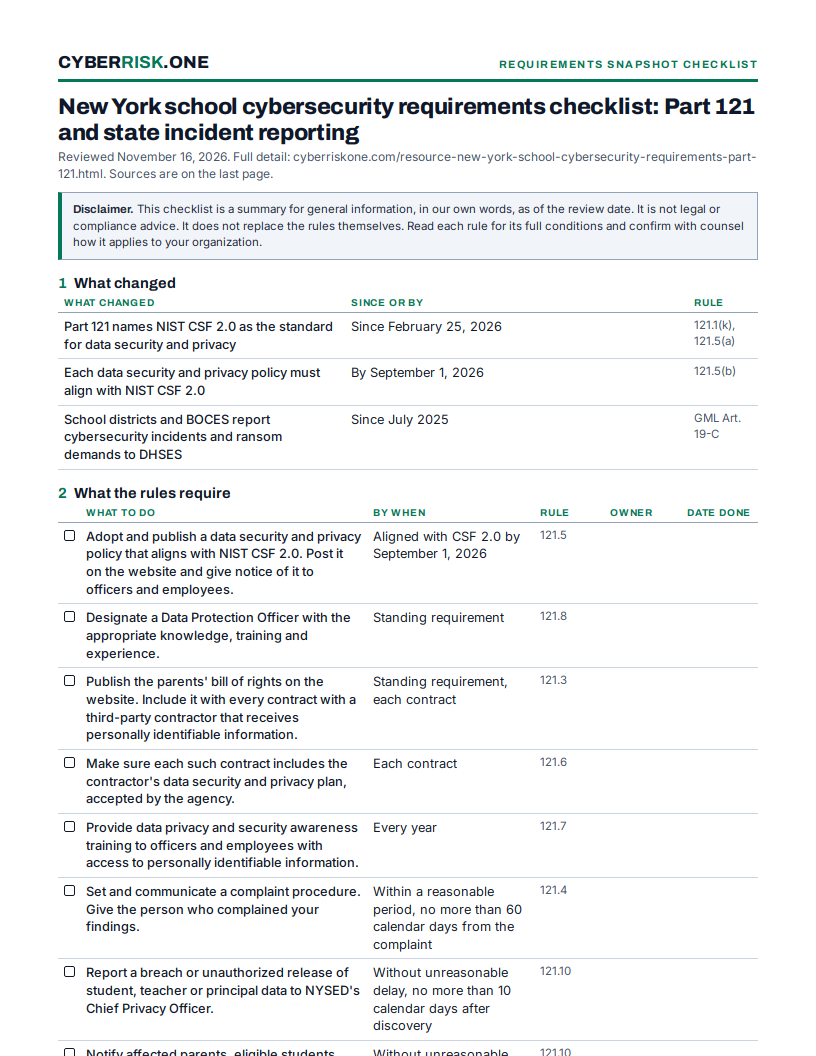
09
How we help
CyberRisk One can help a district with this work in three ways.
A review against NIST CSF 2.0
We review how a district's program lines up with NIST CSF 2.0 and report the result in terms the superintendent and board can act on.
vCISO support to close open findings
Our vCISO service works alongside the district's Data Protection Officer and technology director to close open findings and show the board what was done.
Tabletop exercises for both state reports
We run incident response tabletop exercises that cover the NYSED report and the DHSES report.