NYDFS Part 500 vulnerability management for banks and credit unions: recent examiner findings and what to do now
What NYDFS Part 500 requires of New York state-chartered banks and credit unions for vulnerability management, the gaps DFS says its examiners have found in recent examinations, and what to do now: penetration testing, scanning, timely risk-based remediation and the asset inventory, what the FFIEC and NCUA expect and which remediation deadlines are published.
Free checklist
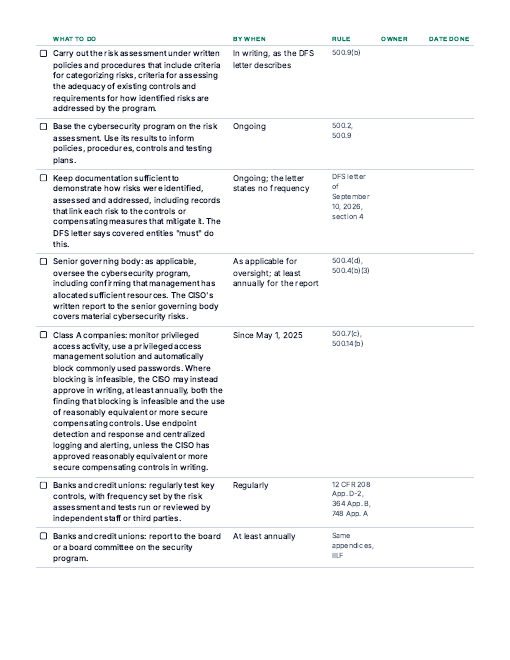
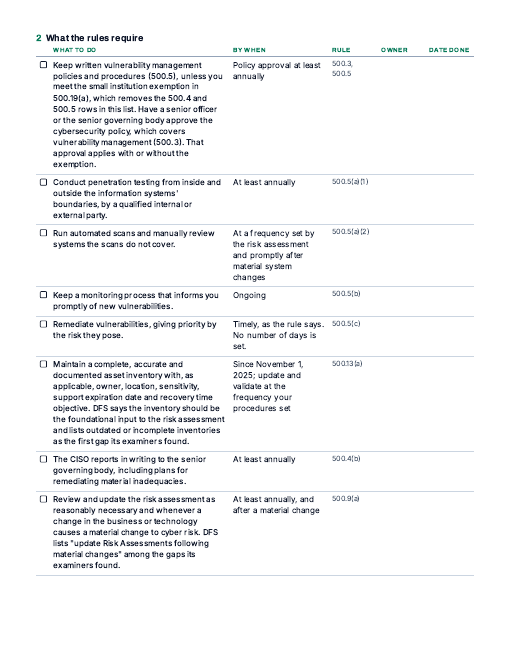
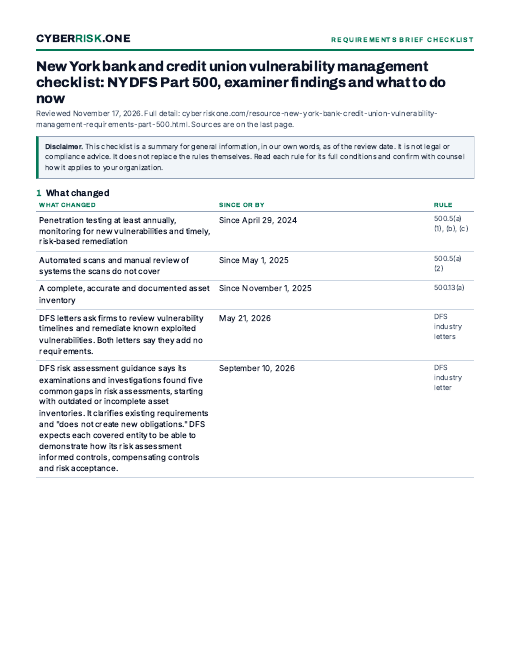
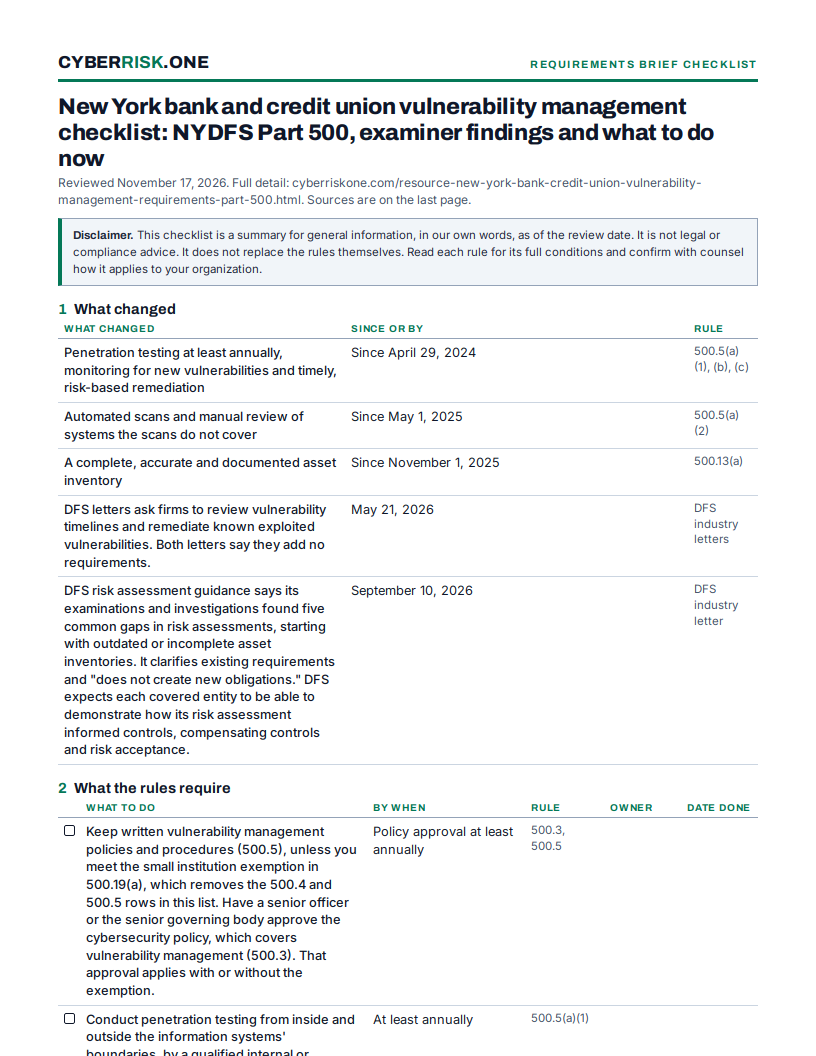
What changed, what the rules require and by when. Print it and assign the items, with sources.
Get the free checklist01
The short answer
NYDFS Part 500 requires a New York state-chartered bank or credit union to run a written vulnerability management program, unless it qualifies for the small institution exemption in 500.19(a), which removes the 500.5 duties.8 The program covers penetration testing at least annually, automated scans with manual review of systems the scans do not cover, monitoring for new vulnerabilities and timely remediation in order of risk.3 Since November 1, 2025 it also requires a complete, accurate and documented asset inventory.56
DFS says its examinations have found common gaps in risk assessments, and the list starts with outdated or incomplete asset inventories. Its September 10, 2026 guidance is meant "to clarify regulatory requirements and highlight best practices" and "does not create new obligations." The duties it cites, such as the inventory in 500.13(a) and the annual review in 500.9(a), already applied. DFS "expects each Covered Entity to be able to demonstrate how its Risk Assessment informed cybersecurity controls, compensating controls, and risk acceptance decisions."30
Part 500, the FFIEC IT Handbook and NCUA guidance set no number of days to fix a vulnerability. They call for timely remediation based on risk.31419 We suggest starting with the written policy or methodology that defines your program. It sets a remediation deadline for each risk tier and puts known exploited and internet-facing vulnerabilities first. Track every finding against it and show the board how you perform.
This page is for CISOs, information security officers, IT leaders, risk and audit leaders and board members at New York state-chartered banks and credit unions.
02
What a mature program is trying to achieve
Shorten the time that exploitable weaknesses stay open on the systems that matter most, and be able to prove it. In our view, a mature program can answer five questions quickly when a new, actively exploited vulnerability is announced.
- 1Which of our systems are affected?
- 2Which of those support payments, deposits, identity or sensitive data?
- 3Who owns the fix?
- 4How long have we been exposed?
- 5What evidence shows the fix or the mitigation worked?
03
What the rules and examiners expect
Part 500 sets the requirements. DFS says what its examiners found when firms fell short. Federal rules and guidance also cover testing, patching and board reporting, with different provisions for banks and for credit unions.
What Part 500 requires you to have
- Written vulnerability management policies and procedures (500.5). A cybersecurity policy that covers vulnerability management, approved at least annually (500.3).34
- A penetration test from inside and outside your information systems' boundaries at least annually, by a qualified internal or external party (500.5(a)(1)).3
- Automated scans, with manual review of systems the scans do not cover, at the frequency your risk assessment sets and promptly after material system changes (500.5(a)(2)).3
- Remediation that is timely and ranked by the risk each vulnerability poses (500.5(c)).3
- A complete, accurate and documented asset inventory (500.13(a)).5
- A written CISO report to the board at least annually that includes plans for remediating material inadequacies (500.4(b)).11
What DFS says its examiners found
- Incomplete asset scope and visibility, starting with outdated or incomplete asset inventories (500.13(a)).305
- Weak or inconsistent methodologies (500.9(b)).30
- Failure to account for evolving and interconnected risks (500.9(a) update duty).30
- Insufficient governance and risk treatment, including no owner, no documented decision and no update after a material change (500.9(a) and (b), 500.4(b)(3) and (d)).30
- Risk assessment results that do not inform the program (500.2, 500.9).30
What your federal supervisor expects
- Banks and credit unions: test key controls regularly, at a frequency set by your risk assessment, with tests run or reviewed by independent staff or third parties.1718
- Banks and credit unions: report to the board or a board committee at least annually, including the results of testing.1718
- Banks: document an exception for any patch you delay or do not apply.15
- Banks: for end-of-life systems, put mitigating controls in place and have a plan to replace the system.16
- Credit unions: install patches "in a timely manner," in NCUA's words.19
What DFS expects you to be able to show
- How your risk assessment informed your controls, compensating controls and risk acceptance decisions. DFS "expects each Covered Entity to be able to demonstrate" this.30
- Documentation sufficient to show how risks were identified, assessed and addressed, with records that link each risk to the controls or compensating measures that mitigate it.30
- A risk assessment reviewed and updated at least annually and whenever a change in business or technology causes a material change in cyber risk (500.9(a)).30
- Confirmation from the senior governing body, as applicable, that management has allocated sufficient resources (500.4(d)).30
- An asset inventory that is accurate and current, which DFS says "should serve as the foundational input to the Risk Assessment" (500.13(a)).305
A small institution that meets the 500.19(a) test is exempt from 500.4 and 500.5. The policy and the asset inventory still apply.8 We found no count of how many banks or credit unions have these findings. DFS gives none, and its letter does not separate banks from other entities.
Read the detail on what Part 500 requires, including the small institution exemption
Each card gives the rule's own terms and its section number. Read each section for its full conditions.345
A written vulnerability management program
Written policies and procedures for vulnerability management. The cybersecurity policy, approved at least annually by a senior officer or the senior governing body, also covers vulnerability management, asset inventory, device management and end of life management. Basis: 500.3 and 500.5.
Penetration testing at least annually
Testing from inside and outside the information systems' boundaries, by a qualified internal or external party. Basis: 500.5(a)(1).
Automated scans and manual review
Automated scans, plus manual review of systems the scans do not cover, at a frequency set by the risk assessment and promptly after material system changes. Basis: 500.5(a)(2).
Monitoring and timely remediation
A monitoring process that informs you promptly of new vulnerabilities. "Timely remediate vulnerabilities, giving priority to vulnerabilities based on the risk they pose." Basis: 500.5(b) and (c).
A complete asset inventory
A "complete, accurate and documented asset inventory" that tracks, as applicable, owner, location, classification or sensitivity, support expiration date and recovery time objectives. The written procedures also set how often it is updated and validated. Basis: 500.13(a).
The CISO's report to the board
A written report at least annually to the senior governing body. It includes "plans for remediating material inadequacies." Basis: 500.4(b).
Extra controls for Class A companies
Monitoring of privileged access activity, a privileged access management solution and automated blocking of commonly used passwords. Where blocking is infeasible, the CISO may instead approve in writing, at least annually, both the finding that blocking is infeasible and the use of reasonably equivalent or more secure compensating controls (500.7(c)). Endpoint detection and response and centralized logging and alerting, unless the CISO has approved reasonably equivalent or more secure compensating controls in writing (500.14(b)). Basis: 500.7(c) and 500.14(b).
Small institutions are exempt from 500.5
An entity that meets the 500.19(a) test is exempt from 500.5, among other sections. The asset inventory and the policy still apply. Basis: 500.19(a).
The remediation duty is risk-based. Section 500.5(c) requires covered entities to "timely remediate vulnerabilities, giving priority to vulnerabilities based on the risk they pose to the covered entity." Part 500 sets no number of days.3
The inventory feeds the rest of the program. Section 500.13(a) requires written policies and procedures for a "complete, accurate and documented asset inventory." The inventory tracks, as applicable, owner, location, classification or sensitivity, support expiration date and recovery time objectives, meaning how quickly a system needs to be restored. The procedures must also set how often the inventory is updated and validated.5 Support expiration dates are what an end of life program works from. Scan coverage can be checked against the same list.
Small institutions have a limited exemption. Section 500.19(a) applies to a covered entity with fewer than 20 employees and independent contractors (counting affiliates), or less than $7,500,000 in gross annual revenue in each of the last three fiscal years, or less than $15,000,000 in year-end total assets. Read 500.19(a) for how each test is counted, including affiliates, before relying on the exemption. Such an entity is exempt from 500.4, 500.5, 500.6, 500.8, 500.10, 500.14(a)(1), 500.14(a)(2), 500.14(b), 500.15 and 500.16.8 It still has to meet 500.3 (policies, including vulnerability management), 500.7 (access privileges), 500.9 (risk assessment) and 500.13 (asset inventory).8 Federal testing expectations, below, still apply.
Class A companies have extra controls. Section 500.1 defines a Class A company by revenue and by employees or worldwide revenue, counting affiliates that share systems or cybersecurity resources.9 A Class A company must also monitor privileged access activity and use a privileged access management solution and automated blocking of commonly used passwords (500.7(c)). If blocking is infeasible, the CISO may instead approve in writing, at least annually, both the finding that blocking is infeasible and the use of reasonably equivalent or more secure compensating controls. A Class A company must use endpoint detection and response and centralized logging and alerting, "unless the CISO has approved in writing the use of reasonably equivalent or more secure compensating controls" (500.14(b)).10 Confirm your status against the text of 500.1.
Part 500 covers New York licensees and charter holders. Part 500 applies to "any individual or organization operating under or required to operate under a license, registration, charter, certificate, permit, accreditation or similar authorization under the Banking Law, the Insurance Law or the Financial Services Law, regardless of whether the individual or entity is also regulated by other government agencies."1 A federally chartered bank or credit union does not hold a New York charter. Confirm with counsel whether any part of your organization holds a New York charter or license.
Read the detail on what examiners and regulators report, including what the letter expects
DFS says its examinations, investigations and interviews have found five common gaps in risk assessments, and the first is an incomplete asset inventory. We could not find a count. No regulator we read says how many banks or credit unions have vulnerability management findings, or what share of exams produce them. Other agencies publish general statements. The OCC names patching and end-of-life systems as supervisory concerns. The Federal Reserve says IT and operational risk matters, which include cyber risk, are its largest category of open items at community and regional banks. We also found no DFS consent order against a bank or credit union that cites 500.5.
DFS wrote that it "reviews Covered Entities' Risk Assessments and information security policies and procedures during examinations and investigations." In "these reviews and in interviews with Covered Entity personnel, DFS has identified common gaps in Risk Assessments which, in turn, have contributed to deficient cybersecurity programs." The letter goes to all DFS-regulated entities. It does not separate banks and credit unions from other entities, gives no count and says the list includes "among others." It says its purpose is "to clarify regulatory requirements and highlight best practices" and that it "does not create new obligations."30
1. Incomplete asset scope and visibility
DFS lists "outdated or incomplete asset inventories; failing to identify where NPI resides or flows; and omitting critical business processes, Third-Party Service Providers, cloud environments, or other external dependencies." NPI is nonpublic information. Basis: The letter says covered entities "are required to maintain an accurate and current asset inventory," citing 500.13(a). It says the inventory "should serve as the foundational input to the Risk Assessment."305
2. Weak or inconsistent methodologies
Failing to consistently identify, analyze, prioritize and document risks, or to evaluate the effectiveness of existing controls. Failing to distinguish inherent risk, the risk before controls, from residual risk, the risk that remains after them. Basis: 500.9(b) requires written risk assessment policies and procedures with criteria for categorizing risks and assessing the adequacy of existing controls. The letter says DFS does not require a specific methodology.30
3. Evolving and interconnected risks
Not accounting for emerging technologies, changes in the threat environment, interdependencies, concentration risk and single points of failure that could materially affect operations. Basis: 500.9(a) requires review and update at least annually and after a material change. The letter's wider points on emerging risks and concentration risk use "should," as best practice.30
4. Insufficient governance and risk treatment
"Failing to assign ownership, document risk response decisions, integrate Risk Assessment results into enterprise governance, or update Risk Assessments following material changes to the business, technology, or threat environment." Basis: 500.9(a) and (b); 500.4(b)(3) and (d). The letter cites no section for assigning ownership.30
5. Results that do not inform the program
Policies, controls and resource decisions "that are not demonstrably based on the Covered Entity's identified cyber risks." Basis: 500.2 requires the program to be based on the risk assessment. 500.9(a) requires the assessment to be "sufficient to inform the design of" the program.30
DFS expects evidence that the risk assessment informed decisions. "The Department expects each Covered Entity to be able to demonstrate how its Risk Assessment informed cybersecurity controls, compensating controls, and risk acceptance decisions." The letter says the risk assessment "must inform and support" decisions on control selection, compensating controls and risk acceptance, citing 500.2 and 500.9.30
DFS encourages firms to review their risk assessments. The Conclusion says the Department "encourages Covered Entities to review their Risk Assessments and Risk Assessment procedures in light of this Guidance," to check whether the right people are engaged, whether scope and methodology fit the entity's size and risk, and whether assessments respond to material changes in operations, technology, data handling, third-party relationships and threats.30
The letter says documentation must link risks to controls. Covered entities "must maintain documentation sufficient to demonstrate how cybersecurity risks were identified, assessed, and addressed." That includes "records that link each identified cybersecurity risk to the specific controls or compensating measures implemented to mitigate the risks identified." The letter adds that the documentation should also record any risk acceptance and its justification. The letter says clear mapping of risks to controls, internal audit and independent testing helps validate that controls are configured correctly and operating as intended.30
The letter lists what Part 500 already requires. The letter's opening says it does not create new obligations. It states as requirements: an accurate and current asset inventory (500.13(a)); a risk assessment reviewed and updated at least annually and after a material change (500.9(a)); written risk assessment policies and procedures (500.9(b)); a program based on the risk assessment (500.2); and, as applicable, the senior governing body confirming that management has allocated sufficient resources (500.4(d)). It also says Part 500 "does not require formal approval of Risk Assessments from a board of directors or senior management." Where the letter says "should," such as covering third-party risk, concentration risk and where nonpublic information flows, it describes best practice and cites no section.30
The letter leaves several points unsaid. It does not say how many entities had these gaps, does not say banks and credit unions had them more or less than others, and does not say DFS will examine more strictly.30
The Federal Reserve's largest open category at community and regional banks is IT and operational risk
Its June 2026 report says that at year-end 2025, IT and operational risk matters requiring attention, "which include cyber risk," were the largest category of outstanding matters for community and regional banking organizations, which are those under $100 billion in assets. The report does not break that category into patching, testing or inventory.33
The OCC names patching and end-of-life systems as concerns
In June 2026 the OCC wrote that its supervision "has identified supervisory concerns related to end-of-life, patch management, and system and data architecture." The report covers the national banks and federal savings associations the OCC supervises. It gives no count. State-chartered banks are outside its scope.32 Its spring 2026 risk report adds that "timely patch management" helps mitigate AI-enabled cyber risks for banks.3532
DFS fined a money transmitter $250,000, in part over an update policy that covered few products
In August 2026 DFS found that Order Express's patching policies "covered only a small number" of the third-party software it uses, leaving it "exposed to known vulnerabilities." For that finding DFS cited 500.3(g) as it read before November 2023. The order also found a risk assessment that did not inform the program (500.9(a) and 500.2(b)). The company is a licensed money transmitter with a limited exemption. It is not a bank or a credit union.34
For credit unions, NCUA's 2026 supervisory priorities letter says the agency "will continue to enforce all laws and regulations applicable to credit unions," including those on information security. It also says examiners will assess governance, risk assessments, vendor management and security frameworks for payment systems.37 NCUA's inspector general, in a February 2026 memo, says NCUA should keep assessing whether credit unions have effective information security programs. That memo is an oversight view. It reports no exam finding.36 We found no NCUA publication that lists exam findings on patching, testing or inventory.
For FDIC-supervised banks, the FDIC's 2025 report says it conducted 1,205 IT examinations of FDIC-supervised institutions and service providers in 2024 and that each report "will detail any weakness in cyber practices." It does not say what weaknesses were found.38 The Federal Reserve's September 2026 report to Congress describes attackers exploiting "n-day" vulnerabilities, meaning those with patches available but not yet applied. That describes threats and reports no exam result.39
Earlier DFS orders against insurers also bear on testing and follow-up. They are insurer cases under earlier versions of Part 500 and do not show a pattern at banks or credit unions. In 2024 DFS found that GEICO had not done annual penetration testing as 500.5 then read, and in 2023 it found that First American did not follow up on a flaw its own penetration test had found.2829
Note: The public record on examiner findings is limited. The figures above come from the agencies' own reports, cover the institutions each agency supervises, and are not New York specific. Several cover all cyber and IT matters. None isolates vulnerability management. The Order Express order and the 2023 and 2024 insurer orders apply earlier versions of the rule. In CyberRisk One's reading, the sources support saying that examiners and DFS name incomplete asset inventories, risk results that do not drive the program, patching, end-of-life systems and policy coverage as concerns. They do not support saying how often banks or credit unions fall short.
Read the detail on what federal supervisors expect
Federal supervisors describe a similar program. Their guidance also sets no number of days.14151718
Banks: the FFIEC IT Handbook
- Identify vulnerabilities, rank them and the affected systems by risk and remediate in a timely way.14
- Scan every system in the inventory, including cloud systems the bank is responsible for.14
- Run a patch process that documents exceptions for patches that are delayed or not applied.15
- For end-of-life systems, put mitigating controls in place and have a plan to replace the system.16
Credit unions: NCUA Part 748
- "Regularly test the key controls, systems and procedures of the information security program."18
- The credit union's risk assessment sets the frequency and nature of the tests. Independent staff or third parties conduct or review them.18
- Report to the board or an appropriate board committee at least annually, including the results of testing.18
- NCUA's 2003 letter says patches should be installed "in a timely manner."19
After the FFIEC assessment tool
- The FFIEC retired its Cybersecurity Assessment Tool on August 31, 2025.21
- The Federal Reserve does not endorse a replacement. It names NIST CSF 2.0, the CISA Cybersecurity Performance Goals, the CRI Profile and the CIS Controls.22
- NCUA continues to support its own voluntary tool, ACET.2021
The FFIEC Handbook gives the bank guidance. The FFIEC Architecture, Infrastructure, and Operations booklet (June 2021) says management should implement a program that "identifies systems and software vulnerabilities, prioritizes the vulnerabilities and the affected systems in order of risk, and performs timely remediation," according to the risk involved. Scans "should include all systems and software in the entity's hardware, software, and telecommunications inventories." Management "should have a method to track and report on the remediation progress of all identified vulnerabilities."14 The Information Security booklet says management "should use vulnerability scanners periodically" and should have "an exception process, with appropriate documentation, for patches that management decides to delay or not apply."15 For a system past its end of life, management should put mitigating controls in place and "have a plan to replace the system or application."16
State member banks and FDIC-supervised banks follow the interagency guidelines. The Interagency Guidelines Establishing Information Security Standards apply to state member banks (12 CFR 208, Appendix D-2) and FDIC-supervised banks (12 CFR 364, Appendix B). They say to "regularly test the key controls, systems and procedures of the information security program" at a frequency and in a manner "determined by the institution's risk assessment." Independent third parties or independent staff conduct or review the tests. The bank reports to its board or a board committee at least annually.17
The credit union guidance uses the same language. NCUA's Guidelines for Safeguarding Member Information (12 CFR 748, Appendix A) use the same testing language for credit unions. They also call for "monitoring systems and procedures to detect actual and attempted attacks." The program is adjusted for "relevant changes in technology." The annual board report covers the risk assessment, risk management and control decisions, service provider arrangements and "results of testing."18 NCUA Letter 03-CU-14 (September 2003) says "it is the software user's responsibility to update systems or install patches in a timely manner."19
The FFIEC named other resources when it retired its tool. The FFIEC retired the Cybersecurity Assessment Tool on August 31, 2025. It said institutions "can instead refer directly to these new government resources," naming NIST CSF 2.0 and the CISA Cybersecurity Performance Goals.21 The Federal Reserve's SR 24-7 also names the CRI Profile and the CIS Controls and does not endorse any one tool.22 NCUA said it "will continue to support and encourage credit unions to use" its Automated Cybersecurity Evaluation Toolbox (ACET).21 NCUA describes ACET as voluntary. It "does not introduce any new requirements or expectations on credit unions."20
04
The practices that follow
These six steps are our suggestions for doing the work above and being able to show it. Write them into your policy or methodology. Adjust each step to your environment, size, risk appetite and other factors unique to you.
- Rank vulnerabilities by exploitation, exposure and importance, then set a deadline for each tierGive priority to the vulnerabilities attackers are already exploiting (known exploited vulnerabilities) and to those on systems reachable from the internet. Then weigh whether attackers can automate the attack, another factor CISA names, and what the system supports, such as payments, deposits, identity or sensitive data. Have the CISO set a deadline for each tier and put the method and the deadlines in the policy described below. Record the review of vulnerability management timelines that DFS's May 2026 frontier AI letter asked for, with its date and decision.
- Run exceptions with an owner and an end dateGive each delayed patch or accepted risk a business owner, documented mitigating controls and an expiry date. Report repeat renewals to the risk committee.
- Give end-of-life systems their own planUse the support expiration dates the inventory holds. For each system that stays in use, document mitigating controls and a replacement plan.
- Check scan coverage against the asset inventoryHave IT list systems in the inventory that are not scanned, and systems found on the network that are missing from the inventory. Also check the inventory against where nonpublic information is stored and moves, and against cloud services and third-party providers. Assign an owner to each gap.
- Close tickets only when the fix is confirmedCount a vulnerability as fixed when a rescan or other test confirms it. Have the risk or security function report the measures, separately from the teams that fix.
- Trace each risk to a control, an owner and a decisionKeep a risk register, a record of each risk and the decision made about it. For each risk it shows the controls or compensating measures, the owner, the decision (treat, transfer or accept) and the residual risk, meaning the risk that remains after the controls. Link vulnerability and patching findings to it. Keep the evidence that the latest assessment drove your control choices and spending.
Read the detail on what your policy or methodology should define
Part 500 requires written vulnerability management policies and procedures (500.5), and a cybersecurity policy that covers vulnerability management, approved at least annually by a senior officer or the senior governing body (500.3).34 The rule names the subjects and activities these documents must cover. It does not say how to organize them or what detail to give. The eight parts below are what we suggest a policy or methodology define.
Note: Each card's Ref line names the rule behind that part or says it is our suggestion. Adjust every part to your institution's environment, size, risk appetite, compensating controls and other factors unique to it.
Scope and inventory
Which systems, applications, cloud services and devices the program covers, tied to the asset inventory. Name what scans cannot reach and how it is reviewed instead. Basis: 500.5(a)(2), 500.13(a), FFIEC Architecture booklet.
How vulnerabilities are found
Scan types and how often each kind of asset is scanned. The annual penetration test. The sources you monitor for new vulnerabilities. Basis: 500.5(a) and (b).
How risk is rated
The method that places each vulnerability in a tier. Combine severity with known exploited status, internet exposure and how important the system is. Basis: 500.5(c); DFS letters, May 2026.
Remediation timelines by tier
A deadline for each tier, counted from detection. A separate deadline for a mitigation and for a permanent fix. What happens when a deadline is missed. Basis: Our suggestion.
Who does what
Who owns each asset, who fixes, who verifies, who approves exceptions and who reports. The people who measure are separate from the people who fix. Basis: Our suggestion.
Exceptions and end-of-life systems
How a delayed or skipped patch is documented and approved, as the FFIEC Handbook describes. We suggest each exception name a business owner, mitigating controls and an expiry date. Mitigating controls and a replacement plan for each end-of-life system. Basis: 500.3(c); FFIEC Information Security booklet II.C.10(d), II.C.11.
Tracking and verification
How every finding is tracked and reported from detection to closure, as the FFIEC Handbook describes. We suggest one system of record and a rule that a finding closes only when a rescan or test confirms the fix. Patches applied in production also reach the disaster recovery environment. Basis: FFIEC Architecture booklet VI.B.3(a); FFIEC Information Security booklet II.C.10(d).
Reporting and review
What the board and the operating team see, and how often. The CISO's annual written report to the board. Approval of the policy at least annually. Basis: 500.3, 500.4(b).
Part 500 names the subjects the policy must cover. Section 500.3 requires a written cybersecurity policy, "approved at least annually by a senior officer or the covered entity's senior governing body," that addresses "asset inventory, device management and end of life management" and "vulnerability management."4 Section 500.5 requires written policies and procedures for vulnerability management that cover penetration testing, automated scans with manual review, monitoring for new vulnerabilities and timely remediation in order of risk.3
The FFIEC Handbook lists parts of a patch process. The Information Security booklet says management should establish a process to monitor for patches, evaluate them against the threat and network environment, prioritize them, obtain, test and install them, keep "an exception process, with appropriate documentation, for patches that management decides to delay or not apply," install production patches in the disaster recovery environment and update the inventory and recovery plans when patches are applied.15 The Architecture, Infrastructure, and Operations booklet adds a method "to track and report on the remediation progress of all identified vulnerabilities."14
The timelines are yours to set. Part 500 and the federal guidance give no days for each tier. The May 2026 frontier AI letter asks firms to review their vulnerability management timelines and decide whether faster detection and remediation are needed.12 The companion letter asks them to remediate known exploited vulnerabilities quickly.13 The table below shows published reference points from other settings. The right days depend on the institution: its systems and how they are exposed, its risk appetite, the compensating controls it has and any factors unique to it. Record the days you choose, the reasons and the date of the review.
Building your timeline tiers: published reference points
| Tier | What falls in it | Published reference points |
|---|---|---|
| 1 | Known exploited vulnerabilities on internet-facing systems or critical services | DFS asks firms to remediate known exploited vulnerabilities "expeditiously." CISA's top tier for federal agencies is 3 days. |
| 2 | Other critical vulnerabilities | A state bank supervisors' paper: 15 days "ideally." PCI DSS: one month for critical patches in the card data environment. |
| 3 | High vulnerabilities | The same paper: 30 days "ideally." |
| 4 | Medium and low vulnerabilities | No published reference point. Set by your risk assessment. |
The board sees how the program performs against the policy. Part 500, the interagency guidelines and NCUA's guidelines each call for a report to the board at least annually.111718 The measures below are our suggestions. Part 500 and the federal guidelines name subjects the report covers, such as plans for remediating material inadequacies and the results of testing. They do not name numerical measures.
For the board or its risk committee, each quarter
- Known exploited and high-impact vulnerabilities open on critical services, with age and owner
- Overdue high-risk items and the oldest items
- The share of critical assets scanned within the interval the policy sets
- Assets with no owner
- Open, expired and repeatedly renewed exceptions
- End-of-life systems still in use and whether each has a funded replacement plan
For the operating team, each week
- Typical time to reduce exposure and to confirm a permanent fix, plus the time within which 90 percent of findings reach each stage
- Age of the open backlog, by tier
- Failed authenticated scans, unreachable systems and inventory mismatches
- Reopened findings and failed patches
Note: Total vulnerability counts, average severity scores and average time to fix measured only on closed tickets can improve while the oldest and riskiest items stay open.
05
What changed and when
The 2023 amendment revised Part 500's vulnerability requirements. The revised provisions applied in stages. The last one, the asset inventory, applied from November 1, 2025.67
How the requirements arrived
- Nov 1, 2023Amendment takes effect
- Apr 29, 2024Testing, monitoring, remediation (500.5)
- May 1, 2025Scans, review, Class A controls
- Aug 31, 2025FFIEC assessment tool retired
- Nov 1, 2025Asset inventory (500.13(a))
- May 21, 2026DFS letters on timelines
Read the detail on what changed and when
Who Part 500 covers
- Any organization operating under a charter or license under the Banking Law, the Insurance Law or the Financial Services Law.1
- That applies "regardless of whether the individual or entity is also regulated by other government agencies."1
- DFS counted 49 state-chartered commercial banks and trust companies and 12 state-chartered credit unions at the end of 2025.2
What took effect in stages
- April 29, 2024: annual penetration testing, monitoring and timely remediation under 500.5.67
- May 1, 2025: automated scans and manual review under 500.5(a)(2).67
- November 1, 2025: the asset inventory under 500.13(a).67
What changed in 2026
- DFS sent two industry letters on May 21, 2026. One asks firms to review vulnerability management timelines. The other asks them to remediate known exploited vulnerabilities quickly.1213
- Both letters say they add no requirements.1213 In October 2026 DFS urged firms again to remediate known exploited vulnerabilities quickly, in an alert on PHP.31
- On September 10, 2026 DFS issued risk assessment guidance. It lists common gaps its examinations found, lists vulnerability scans and penetration testing as inputs to a risk assessment, and says it "does not create new obligations."30
- In June 2026 CISA moved federal agencies to tiered deadlines. That directive covers federal civilian agencies only.23
The 2023 amendment set the dates. The second amendment to Part 500 took effect on November 1, 2023. Section 500.22 gave covered entities 180 days for most new requirements, one year for 500.4, 18 months for 500.5(a)(2), 500.7, 500.14(a)(2) and 500.14(b) and two years for 500.13(a).6 DFS's timeline for covered entities lists April 29, 2024 for 500.5(a)(1), (b) and (c): "Conduct at least annual penetration testing from inside and outside information systems' boundaries" and "Prioritize and timely remediate vulnerabilities based on risk."7 Automated scanning under 500.5(a)(2) and the Class A controls in 500.7 and 500.14(b) followed on May 1, 2025. The asset inventory under 500.13(a) followed on November 1, 2025.67
The May 2026 letters are guidance. One letter, on heightened risk from frontier AI models, says regulated entities should "review vulnerability management timelines" and decide whether faster detection and remediation are needed. It "does not impose any new requirements."12 The other, on a heightened threat environment, says entities should "expeditiously identify and remediate known exploited vulnerabilities," especially on internet-facing systems. It "does not establish new legal requirements."13
Federal agencies now work to tiered deadlines. CISA's Binding Operational Directive 26-04, issued June 10, 2026, revoked BOD 19-02 and BOD 22-01. It sets deadlines by tier, based on asset exposure, known exploited status, exploit automation and impact. The top tier is three days and includes forensic triage, a first check of the asset for signs of compromise. It applies to federal civilian agencies only.23
06
Published deadlines and where they apply
Part 500, the FFIEC IT Handbook and NCUA guidance set no number of remediation days. The published numbers below come from other rules and settings. One of them, PCI DSS, applies to an institution's card data environment.23242526
Published remediation targets and one measured result, in days
The published numbers set no reference point for medium and low vulnerabilities. We found no public data on what banks or credit unions actually achieve against any of them.
Read the detail
Federal agencies have had set deadlines. CISA's BOD 19-02 (April 2019) required federal agencies to fix critical vulnerabilities on internet-accessible systems within 15 calendar days of detection and high ones within 30.24 BOD 26-04 revoked it in June 2026 and replaced flat deadlines with tiers.23 Both apply to federal agencies only.
PCI DSS sets a deadline for card data. PCI DSS Requirement 6.3.3 calls for patches for critical vulnerabilities to be installed "within one month of release." That applies to the card data environment.25
State bank supervisors published a guide. A Conference of State Bank Supervisors paper on vulnerability and patch management, posted by the Massachusetts Division of Banks, says that "ideally" critical vulnerabilities are remediated within 15 calendar days of initial detection and high ones within 30. The paper is guidance. It does not set a requirement.26
The data covers all industries. Verizon's 2026 Data Breach Investigations Report says organizations in its data set fully remediated 26 percent of the vulnerabilities on CISA's known exploited list in 2025, down from 38 percent the year before. The median time to full resolution rose to 43 days from 32. That data set covers all industries. It does not break out financial institutions.27
This is our reading. Given the May 2026 letters and the federal move to tiers, we suggest setting deadlines by tier, with known exploited and internet-facing vulnerabilities first. Measure time to mitigation separately from time to a permanent fix. The tiers and the separate deadlines are our suggestions. Section 500.5(c) requires timely remediation in order of risk and sets no number of days.
Free checklist
Get the checklist
Give us your email and we will send you a link to the downloadable checklist: what changed, what the rules require and what we suggest. 32 items you can print and assign, with the deadline and rule number for each requirement.
07
How we help
CyberRisk One helps banks and credit unions build and run vulnerability management programs that examiners and boards can follow.
Vulnerability management, run with you
We set up and run scanning, prioritization and exception handling, with timelines set by risk and reporting the board can read.
A Part 500 review
We review your program against Part 500 and the FFIEC or NCUA expectations and show where the records an examiner would ask for are missing or incomplete.
vCISO support
Our vCISO service works with your team to set the timelines, report to the board and close open findings.